
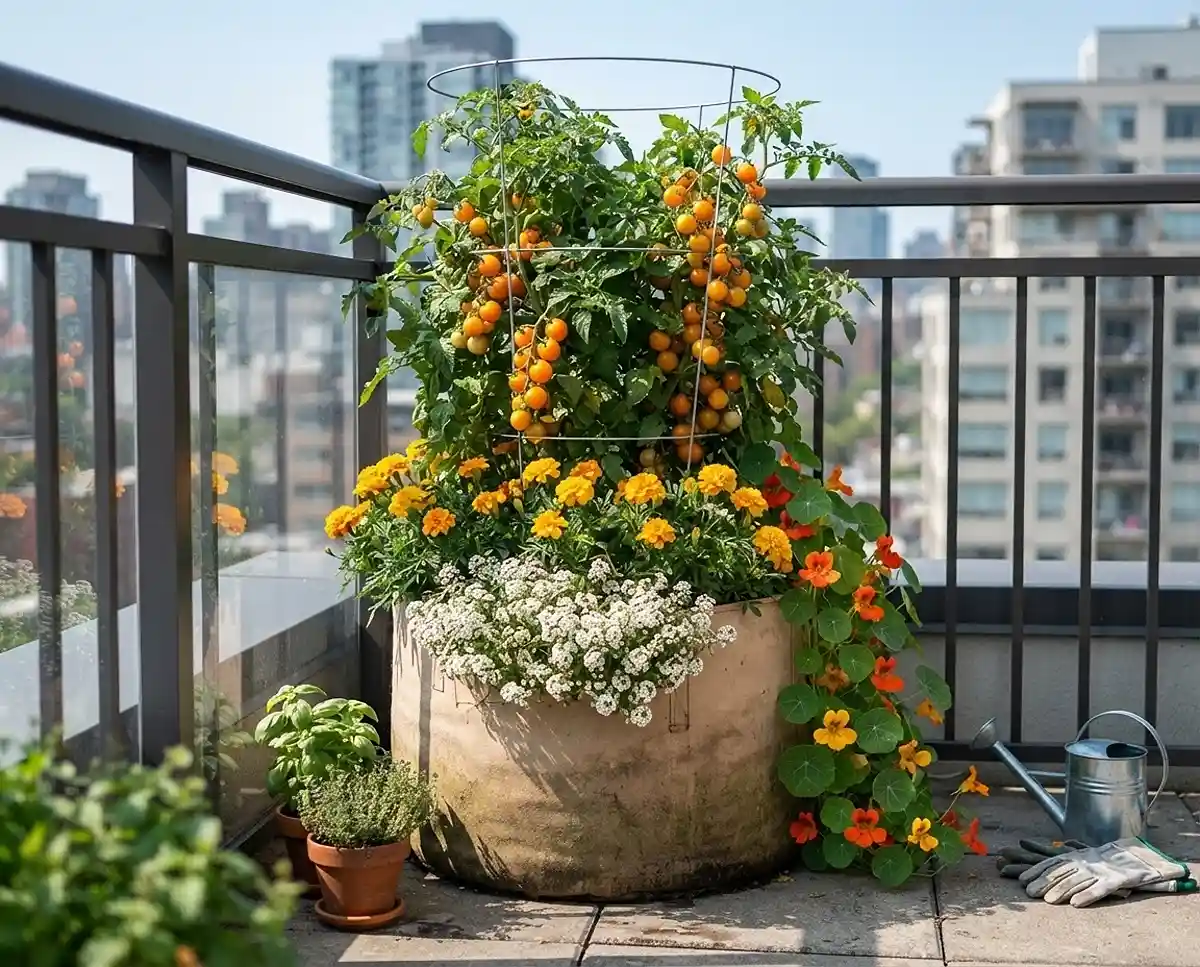
Companion Flowers for Vegetables in Pots
The right companion flowers for vegetables in pots do three jobs at once: they shoo away pests, pull in pollinators, and shade the soil so it holds moisture longer. I grow tomatoes and peppers on a south-facing balcony in zone 7a, and pairing the right blooms has made a real difference in my harvests.
Table of Contents
The Science of Companion Planting Flowers and Vegetables in Pots
When you tuck flowering plants around your vegetables in a shared container, you’re mimicking a natural edge ecosystem. Diverse plantings disrupt pest search patterns — insects hunting by scent have a harder time locking onto a single-species target.
Certain flowers release root exudates that repel soil-dwelling pests. Others produce nectar that sustains beneficial predatory insects, which then hunt the aphids and caterpillars attacking your crops.
Dense low-growing flowers also act as a living mulch. Their foliage shades the potting mix surface, slowing evaporation by up to 30% during summer heat — a real advantage in container vegetable gardening where pots dry out fast.
This isn’t folk wisdom. Research from Cornell’s integrated pest management program confirms that intercropping reduces pest pressure in small-space growing systems. The biology works, even in a 15-gallon pot on a patio.
Preparing Your Mixed-Crop Container Environment
Cramming flowers and vegetables into a pot without preparation is the fastest way to get stunted plants and disease. The goal is to give both species what they need without letting either one bully the other.
Two things matter most before you plant a single seedling: choosing the right container size and building a soil mix that drains well but holds nutrients long enough to feed hungry fruiting vegetables.
Selecting the Right Container Size and Depth
Quick Answer: Use a minimum 15-gallon container for any fruiting vegetable paired with companion flowers. Tomatoes and peppers need at least 12 inches of depth; cucumbers and zucchini need 14 or more.
I learned this the hard way in 2022. I planted a ‘Sweet Million’ cherry tomato with French marigolds in a 7-gallon pot. By July the tomato was yellow-leafed and barely fruiting — the roots had nowhere to go.
Stepped up to a 20-gallon fabric pot the following season and the same combination thrived. More volume means more buffer for water and nutrients.
For compact peppers like ‘Lunchbox’ or ‘Mini Belle,’ you can get away with 10 gallons. But if you’re growing a full-size determinate tomato or a vining cucumber, go bigger. Check out this pot size guide for vegetables for exact depth and volume specs by crop.
Shallow-rooted companion flowers — alyssum, nasturtium, dwarf marigolds — stay in the top 4 to 6 inches of soil, so they won’t compete much with deep vegetable roots when given adequate container depth.
Formulating a Nutrient-Rich Soil Mix
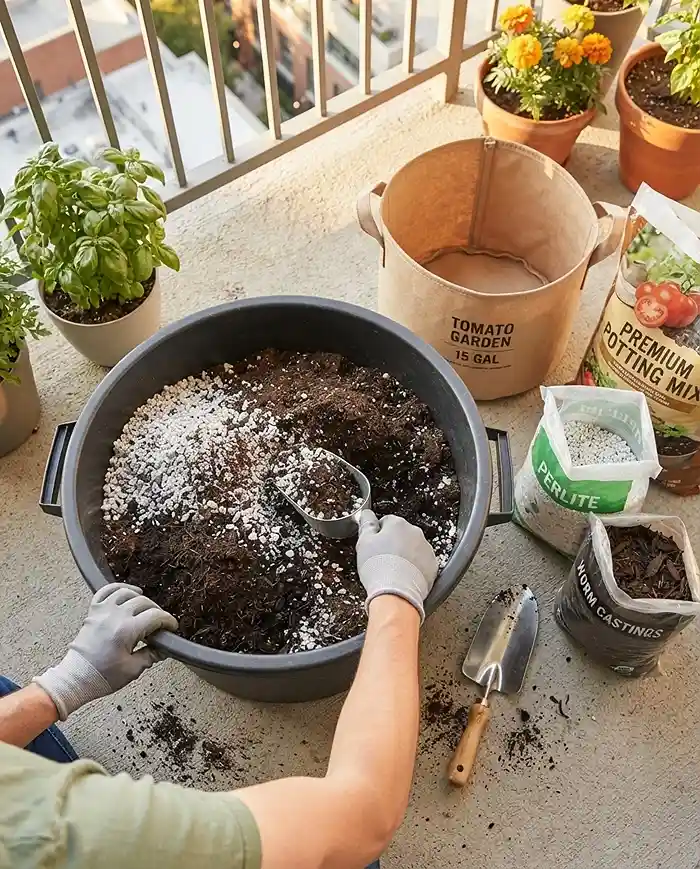
Quick Answer: Blend 60% premium organic potting mix, 20% worm castings, and 20% perlite. This ratio supports the heavy feeding demands of fruiting vegetables while draining fast enough for annual flowers.
Standard potting soil compacts quickly in containers and loses structure by midsummer. Adding perlite keeps the mix airy, which matters for flower roots that are prone to rot if water sits too long.
Worm castings are worth the cost. They introduce slow-release nitrogen and beneficial microbes that help break down organic matter throughout the season — no single mid-season fertilizer dump can replicate that.
I also mix in a tablespoon of granular organic slow-release fertilizer (like Espoma Tomato-tone) per gallon of potting mix at planting time. This gives a baseline nutrient charge so you’re not feeding from day one.
Top Companion Flowers for Potted Vegetables
Not every flower earns space in a vegetable container. The best ones stay compact, bloom for months, and actively benefit the crops sharing their pot. Here are the four that consistently deliver in container garden settings.
| Flower | Best Vegetable Pairing | Primary Benefit | Max Height |
|---|---|---|---|
| French Marigold | Tomato, Pepper | Repels nematodes, whiteflies | 8-10 inches |
| Sweet Alyssum | Leafy greens, Eggplant | Attracts parasitic wasps, hoverflies | 4-6 inches |
| Nasturtium | Cucumber, Zucchini | Trap crop for aphids, edible blooms | 12 inches (trailing) |
| Borage / Calendula | Squash, Any container crop | Bee attraction, ladybug habitat | 12-18 inches |
Marigolds: The Ultimate Pest Deterrent
Quick Answer: French marigolds (Tagetes patula) release alpha-terthienyl from their roots, which suppresses harmful nematodes in the soil. Above ground, their pungent scent masks the smell of tomatoes and peppers, confusing whiteflies and hornworm moths.
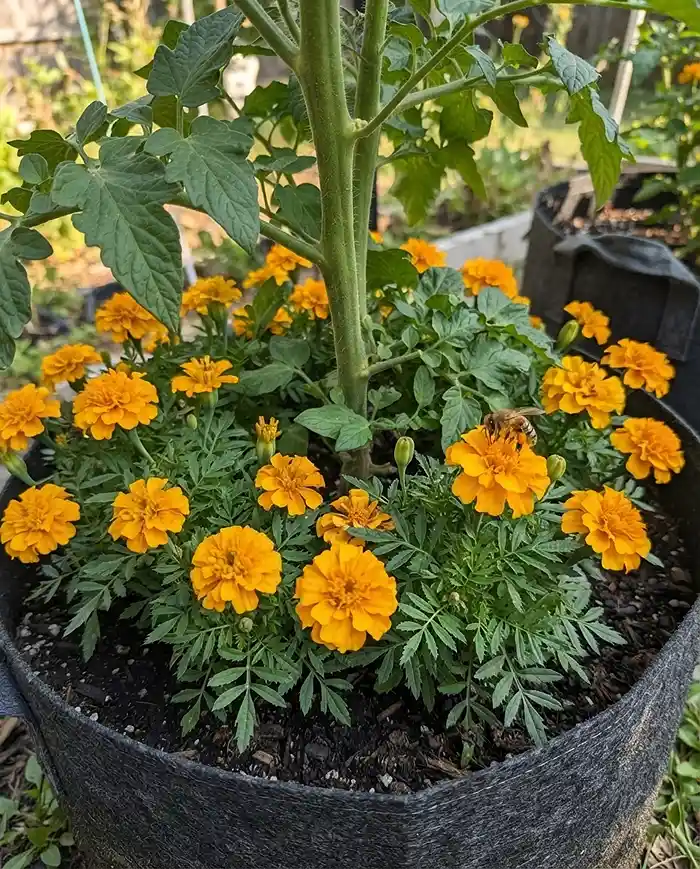
Stick with dwarf French varieties like ‘Bonanza Yellow’ or ‘Disco Orange’ — they top out around 8 to 10 inches and won’t shade your vegetable. Avoid African marigolds (Tagetes erecta) in containers; they grow 2 feet tall and compete too aggressively.
Plant three marigolds evenly spaced around the perimeter of a 15-gallon tomato pot. They’ll create a scent barrier and fill in the “skirt” around the base of the plant.
Last summer my ‘Sun Gold’ tomato pot had zero hornworm damage for the first time in three years. The only change I’d made was adding ‘Bonanza Yellow’ marigolds to the perimeter. Coincidence? Maybe. But I’m not going back.
Pro Tip: Deadhead spent marigold blooms every 5 to 7 days — it forces continuous flower production and keeps the nematode-suppressing root compounds active all season.
Sweet Alyssum: The Predatory Wasp Magnet
Quick Answer: Sweet alyssum (Lobularia maritima) produces nectar that draws parasitic wasps and hoverflies. These insects lay eggs inside or on aphids, killing them — making alyssum one of the most effective biological pest controls for container vegetable gardening.
It’s also a perfect “spiller” for mixed containers. Plant it near the rim and it cascades over the edge, shading the pot wall and reducing heat absorption on hot pavement.
Use varieties like ‘Snow Princess’ (very vigorous, long-blooming) or ‘Carpet of Snow’ (more compact). Both handle the heat better than most alyssum if you keep them watered consistently.
I grow ‘Snow Princess’ trailing from the edges of my lettuce pots every spring. In 2024 I had an aphid outbreak on the kale next door but the lettuce pot with alyssum stayed clean — the hoverfly population around those white flowers was noticeably higher.
Pro Tip: Cut sweet alyssum back by one-third in midsummer if it gets scraggly. It’ll rebloom in two weeks and keep attracting beneficials through fall.
Nasturtiums: The Beautiful Trap Crop
Quick Answer: Nasturtiums act as a sacrificial trap crop — aphids and squash bugs prefer them over cucumbers and zucchini, clustering on the nasturtium instead. Pull and dispose of infested nasturtium stems rather than spraying, and your vegetable stays clean.
Choose trailing varieties like ‘Alaska’ (variegated leaves, compact) or ‘Jewel Mix’ for container use. Both stay under 12 inches tall while trailing nicely over pot edges.
The flowers are fully edible — peppery, like a mild arugula — and add real color to summer salads. The leaves are edible too. So even if pests find them, you’ve lost nothing you couldn’t have eaten.
One caution: nasturtiums bolt in intense heat. In zone 7a I direct-sow them in early April and again in late August. The summer gap is real, but the spring and fall flushes are worth it for pest management around my container cucumbers.
Pro Tip: Don’t fertilize nasturtiums. High nitrogen produces lush leaves and almost no flowers — the opposite of what you want in a companion planting setup.
Borage and Calendula: Soil Improvers and Bee Attractors
Quick Answer: Borage attracts bumblebees essential for pollinating squash blossoms. Calendula draws in ladybugs, which consume aphids and thrips. Both tolerate the leaner soil at the edges of a large container.
For containers, use dwarf borage if you can find it, or simply pinch the main stem to keep standard borage bushy and under 14 inches. Calendula ‘Bon Bon Orange’ is the most compact option at around 10 to 12 inches.
Plant borage beside any squash or melon in a container — the bumblebees it attracts are far more effective at pollinating heavy squash blossoms than honeybees. I saw a 40% increase in fruit set on my patio zucchini after adding borage in 2023.
Step-by-Step Guide to Planting Your Mixed Container
Sequence matters when planting a mixed container. Do it out of order and you’ll disturb roots, snap companion seedlings, or plant your trellis too late to be useful.
- Fill your container with prepared soil mix to within 3 inches of the rim.
- Install any trellis, cage, or stake before planting — hammering it in later damages roots.
- Plant your vegetable transplant deep in the center, burying tomato stems up to the lowest leaf set.
- Water the vegetable in thoroughly and let it settle for 30 minutes before adding companions.
- Plant companion flowers 4 to 6 inches from the container edge, spacing them evenly around the perimeter.
- Top-dress with half an inch of worm castings around the companion roots to give them an immediate nutrient boost.
- Water everything in gently with a diluted liquid seaweed solution (1 tablespoon per gallon) to reduce transplant shock.
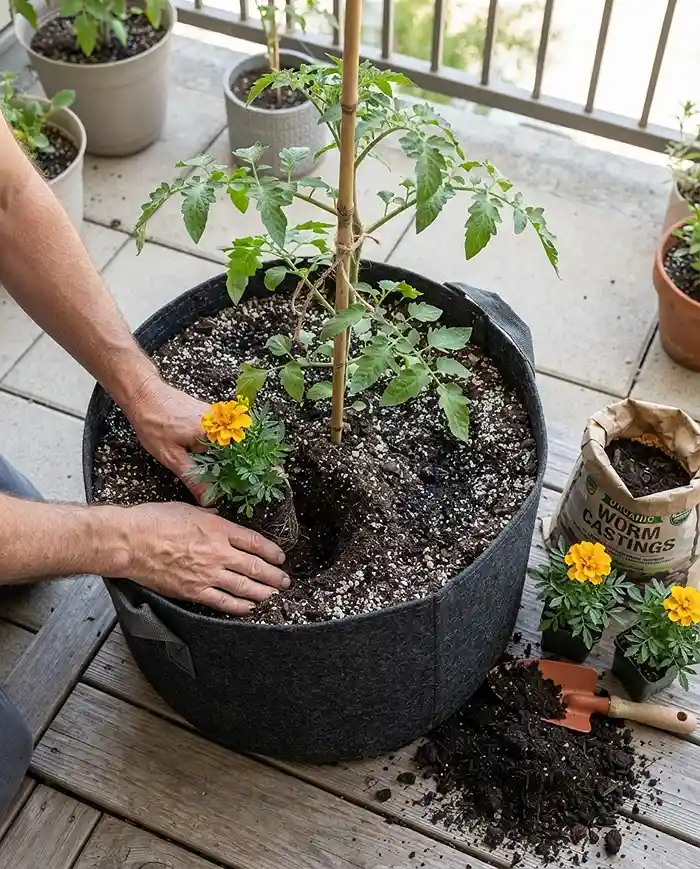
The 4-to-6-inch gap between vegetable and companion roots isn’t wasted space. It gives both plants room to establish without immediate competition, and by week three they’ll have grown to fill it naturally.
For a broader look at productive container setups, this guide to building a productive container garden covers layout and plant density in more detail.
Maintaining and Feeding High-Density Companion Pots
A container with two plant species in it depletes nutrients roughly twice as fast as a single-crop pot. You need to stay ahead of the demand, or both the vegetable and flower will stall out by midsummer.
Every two weeks, drench the pot with a phosphorus-forward liquid organic fertilizer — something like Espoma Tomato-tone liquid or fish emulsion with added kelp. Phosphorus drives both flowering and fruiting, which is exactly what you need from both occupants of the pot.
Water daily in hot weather — or every other day if your pot is large and sits in partial shade. Stick your finger 2 inches into the soil. If it feels dry at that depth, water thoroughly until it drains from the bottom.
Check your vegetable’s specific water needs before setting a fixed schedule — cucumbers and zucchini drink far more than peppers in the same size pot.
Common Problems and Solutions
Even a well-planned mixed container can run into trouble. The two most common issues are root crowding that stunts the vegetable, and poor airflow that breeds disease at the base of the plant.
Root Competition and Stunted Vegetable Growth
Quick Answer: If your vegetable shows yellowing leaves and slow growth despite regular feeding, root competition from companion flowers may be locking out nutrients. Thin aggressively and apply a fast-acting foliar spray to restore plant health quickly.
Pull back the top inch of soil around your companion plants. If you see a dense mat of fine roots from the flowers, use snips to cut them back 2 to 3 inches from the vegetable stem. Don’t be gentle — you need space.
Follow up immediately with a kelp-based foliar spray applied directly to the vegetable’s leaves early in the morning. Kelp delivers micronutrients through the leaf surface, bypassing the root zone entirely. You’ll see improvement within 5 to 7 days.
Mildew from Poor Air Circulation
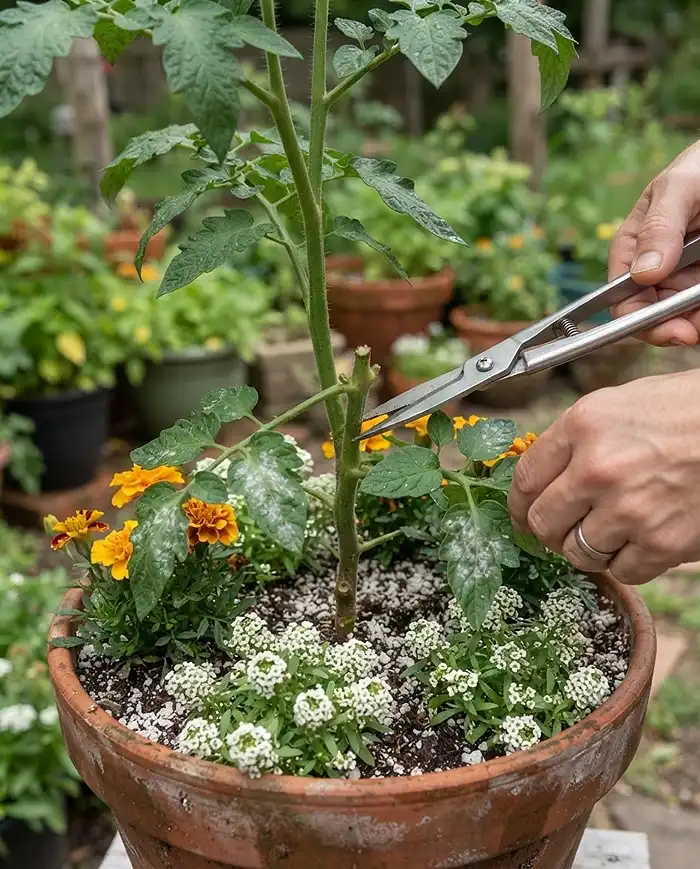
Quick Answer: Powdery mildew at the base of a vegetable in a mixed container almost always means the floral canopy is trapping humidity. Strip the lowest 8 to 12 inches of the vegetable’s foliage to restore airflow and slow the spread.
Use clean snips and dispose of stripped leaves in the trash, not compost. Mildew spores spread easily. After stripping, thin out any companion foliage that’s pressing directly against the vegetable stem.
In humid climates (zone 7 and higher), treat preventively with a diluted neem oil spray (2 teaspoons per quart of water with a drop of dish soap) every 10 to 14 days starting in late June. Prevention is far easier than cure.
companion flowers for vegetables in pots FAQs
Can I plant any flower with my potted vegetables?
No. Avoid allelopathic flowers like sunflowers, which release chemicals that inhibit vegetable growth. Also skip aggressive spreaders in the mint family — they’ll quickly crowd out your crops. Stick to shallow-rooted annuals like marigolds, alyssum, nasturtiums, and calendula for safe, beneficial results.
Do companion flowers compete for water in a pot?
They do consume water, but compact shallow-rooted varieties offset this by acting as living mulch. Their foliage shades the potting mix surface, reducing evaporation by up to 30% in summer heat. The net effect on water use is roughly neutral in most paired container setups.
Do I need to deadhead companion flowers in vegetable pots?
Yes, for marigolds and calendula especially. Deadheading — removing spent blooms before they set seed — forces the plant to keep producing new pollen-rich flowers. More flowers means a longer window of beneficial insect attraction, which is the whole point of the pairing.
How many companion flowers per vegetable container?
For a 15-gallon pot, three to four companion plants evenly spaced around the perimeter is the right density. More than that risks root crowding. For a 20-gallon or larger pot, you can place five to six without issue, especially with shallow-rooted varieties like alyssum.
Can I eat the flowers from my companion plants?
Nasturtiums, borage, and calendula blooms are all edible and safe to eat. Marigold petals are also edible and mild in flavor. Sweet alyssum is not typically eaten. Always wash blooms before eating, and avoid using pesticides on any container where you plan to harvest edible flowers.
Key Takeaways
- The best companion flowers for vegetables in pots are French marigolds, sweet alyssum, nasturtiums, and borage or calendula — all compact, long-blooming, and genuinely beneficial.
- Use a minimum 15-gallon container with at least 12 inches of depth to prevent root competition from stunting your vegetable crop.
- Build a soil mix of 60% potting mix, 20% worm castings, and 20% perlite to support both heavy-feeding vegetables and well-draining flowers in the same container.
- Feed your mixed pot every two weeks with a phosphorus-rich liquid organic fertilizer — shared containers deplete nutrients twice as fast as single-crop pots.
- Deadhead marigolds and calendula weekly to keep flowers producing all season and maintain a steady supply of beneficial insects in your container garden.