

Minimalist Balcony Garden Ideas with Olive Green and Terracotta
These minimalist balcony garden ideas prove you don’t need a lot of space — or a lot of plants — to create something stunning. A strict palette of warm terracotta and muted olive green is all it takes to turn a cluttered rental balcony into a calm, cohesive retreat.
I grow an ‘Arbequina’ olive tree and a cluster of Agave attenuata on a south-facing balcony in zone 7b. The setup took one afternoon to arrange and almost no maintenance since. That’s the real appeal of this aesthetic — it looks intentional without demanding constant attention.
Table of Contents
Embracing the Minimalist Balcony Aesthetic with Terracotta and Olive Green
Most urban balconies become dumping grounds — mismatched plastic pots, half-dead herbs, a faded chair. The visual noise is exhausting.
Restricting your palette to terracotta clay and olive-green foliage does something almost magical. Every element suddenly belongs. The warm orange-brown of unglazed clay plays directly off sage and silver-green leaves, creating that effortlessly sophisticated Mediterranean retreat you’ve been pinning for years.
This is what sets a strong minimalist balcony garden apart from a generic one: constraint is the design. You’re not decorating. You’re editing.
The fewer elements you choose, the more each one lands. Three well-chosen terracotta planters with architectural greenery will always outperform twenty mismatched pots crammed with annuals.
The Design Psychology of a Restricted Color Palette
Minimalist landscape design works on a simple principle: limit visual decision-making so the eye can rest. On a small balcony garden, every competing color is a distraction that shrinks the perceived space.
When terracotta and olive green are your only two variables, the brain reads the space as intentional and expansive — even if it’s just 40 square feet. That’s not styling advice. It’s how visual perception actually works.
Terracotta as a Grounding Warm Neutral
Unglazed terracotta is one of the few materials that genuinely improves as it ages. The clay develops a patina — subtle salt bloom, slight darkening — that looks more expensive over time, not less.
For a minimalist look, skip the flared-rim cottage pots. Instead, choose smooth U-shaped cylinders or clean rectangular troughs. The silhouette should be geometric and quiet.
I made the mistake of buying ornate embossed pots my first season. They competed with the plants instead of framing them. I replaced them with plain cylinder pots from a local pottery supplier and the whole balcony instantly looked more intentional.
Pro tip: Stick to one terracotta brand or kiln if possible — slight color variations between manufacturers can subtly undermine the cohesion you’re building.
Olive Green Foliage for Textural Contrast
Bright-flowering annuals are the enemy of this aesthetic. Petals drop, colors clash, and the whole look reads as busy within a week.
Instead, select plants strictly within the silver, sage, and olive-green spectrum. Your visual interest comes from leaf texture — the waxy smoothness of a jade plant next to the spiky geometry of an agave next to the feathery silver of a eucalyptus.
This monochromatic foliage approach is what gives the best apartment balcony garden ideas their staying power. The look doesn’t change week to week — it matures slowly and consistently.
Assessing Your Space and Selecting Containers
Before you buy a single pot, two things need checking: your balcony’s weight limit and its sun exposure. Terracotta is heavy. Wet soil in a large clay pot can exceed 80 lbs. Get both numbers wrong and you’re either cracking your balcony slab or killing drought-tolerant plants with shade.
Check your building’s structural load specs — most modern balconies handle 40–60 lbs per square foot, but older buildings can be lower. When in doubt, ask your building manager before you commit to large clay containers.
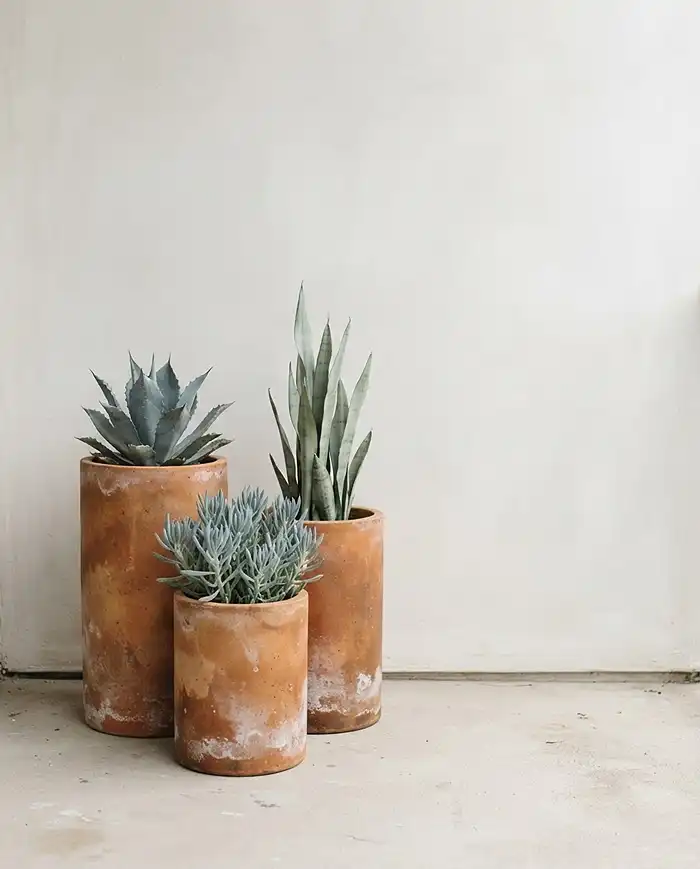
Choosing Minimalist Terracotta Shapes
Quick Answer: Abandon traditional flared-rim pots. For a minimalist look, use modern U-shaped cylinders or tall tapered square terracotta planters. Apply the rule of three: cluster 3 large high-impact containers instead of scattering a dozen small ones.
Large containers do more design work per square inch. A single 18-inch cylinder planted with a trained olive tree is a focal point. Eighteen 4-inch terracotta pots with succulents is a collection — and collections look cluttered.
- Cylinders (12-18 inch diameter): Best for single specimen plants like olive trees or snake plants
- Rectangular troughs (24+ inches long): Ideal flush against the railing for low groundcover or herbs
- Tapered square pots (10-14 inch): Good for mid-height structural plants like jade or aloe
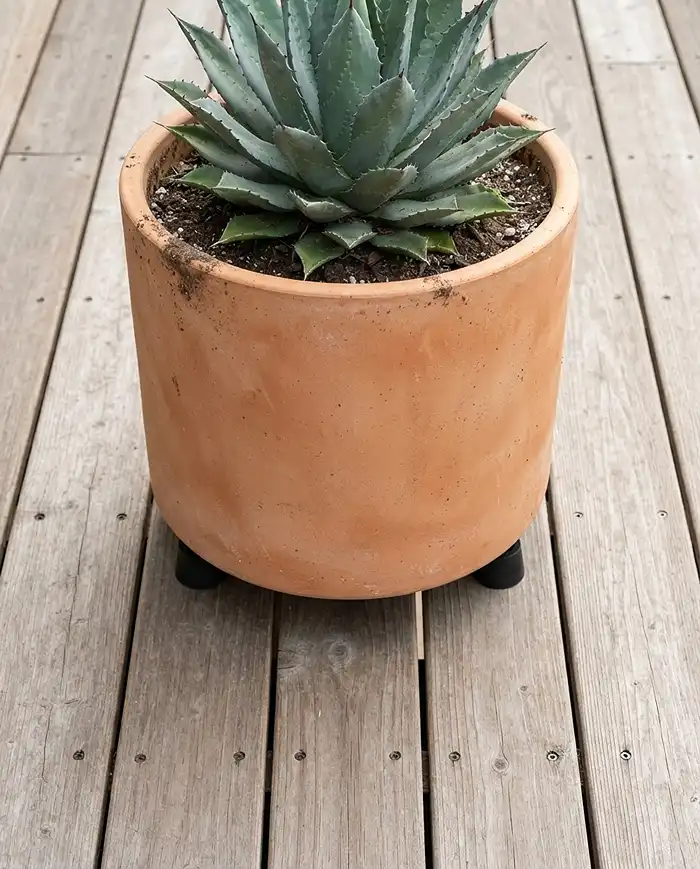
Floor Protection and Weight Limits
Quick Answer: Calculate your balcony’s weight capacity before buying large clay pots. Use rubber pot feet under every terracotta container to prevent permanent moisture rings on your decking.
Terracotta wicks moisture outward through its walls, which means the base of the pot stays wet. Set a large pot directly on a wood deck for one season and you’ll have a permanent dark ring. Rubber feet — small, invisible, cheap — create just enough airflow to prevent this.
For weight, a rough guide: a dry 16-inch terracotta pot weighs around 15 lbs. Fill it with standard potting mix and water it thoroughly, and you’re looking at 50-60 lbs. Multiply across five pots and it adds up fast.
Best Olive Green Plants for a Minimalist Look
The plants that work best in this palette are “architectural” — meaning their form is interesting on its own, without flowers. They have strong silhouettes, minimal leaf drop, and don’t need constant deadheading to stay tidy.
Avoid high-maintenance annuals entirely. They demand frequent replacing, drop petals that stain clay pots, and break the visual discipline you’ve worked to establish.
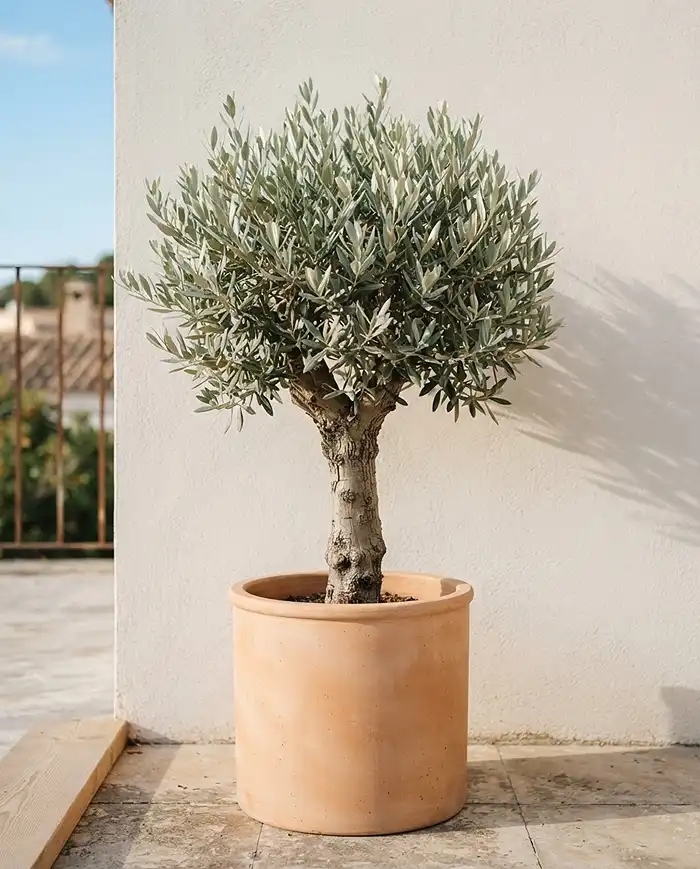
Potted Olive Trees and Silver-Green Shrubs
Quick Answer: ‘Arbequina’ olive trees and ‘Silver Drop’ eucalyptus are ideal focal plants for a terracotta-and-olive-green balcony. Both thrive in containers with a sandy, fast-draining mix and full sun.
I’ve kept an ‘Arbequina’ in an 18-inch terracotta cylinder for three years in zone 7b. It stays compact naturally, rarely needs pruning, and the silver-green foliage hits exactly the muted, sophisticated tone this palette needs.
The soil mix is non-negotiable: standard potting mix is too heavy and too moisture-retentive for Mediterranean plants in clay pots. Blend 60% premium potting mix with 30% perlite and 10% coarse sand. This drains fast enough to prevent root rot while the terracotta handles residual moisture.
- ‘Arbequina’ Olive (Olea europaea): Compact, slow-growing, zones 8-11 (overwinter indoors in colder zones)
- ‘Silver Drop’ Eucalyptus: Stunning silver-blue foliage, grows fast, needs hard cutback each spring
- Lavender ‘Hidcote’: Grey-green foliage, borderline acceptable purple flowers that dry well
For broader inspiration on this Mediterranean direction, the Mediterranean balcony garden guide covers companion plants and layout strategies in more depth.
Architectural Succulents for Clean Lines
Quick Answer: Agave attenuata, Jade plants (Crassula ovata), and upright Snake Plants (Sansevieria trifasciata) deliver strong geometric shapes with almost zero maintenance. Their rigid structure complements minimalist design and requires watering only every 10-14 days in summer.
I tried a flowering kalanchoe in my terracotta display in spring 2023. The orange blooms were pretty but completely wrong — they clashed with the earthy palette and dropped messy petals for weeks. I replaced it with a ‘Moonshine’ Sansevieria and the design clicked back into place immediately.
| Plant | Best For | USDA Zones | Watch Out For |
|---|---|---|---|
| Agave attenuata | Bold focal point, no spines | 9-11 | Needs large (16″+) pot; dies after flowering |
| Crassula ovata (Jade) | Mid-height structure | 10-12 (indoors elsewhere) | Prone to root rot in heavy soil |
| Sansevieria ‘Moonshine’ | Silver-green vertical accent | 9-11 | Sluggish growth in low light |
| ‘Arbequina’ Olive | Tall specimen tree | 8-11 | Needs 18″+ pot; overwintering below zone 8 |
| ‘Silver Drop’ Eucalyptus | Feathery silver foliage | 8-10 | Fast grower; needs hard annual cutback |
Step-by-Step Guide to Styling Your Minimalist Balcony
Start with placement before you buy a single plant. The tallest container — your olive tree or eucalyptus — goes in the far corner. This draws the eye outward and upward, making the balcony feel larger than it is.
Align your rectangular terracotta trough flush against the railing. Low and horizontal, it anchors the railing line without blocking the view or the light. Keep it planted with something compact — a row of ‘Hidcote’ lavender or trailing rosemary works well.
This is the rule most people break: keep the central floor space completely empty. No chairs pushed to the wall, no stacked pots, nothing. The void is the design. Empty space on a small balcony garden reads as abundance, not absence.
If you need seating, use a single low stool or folding chair tucked beside the tall corner specimen. One seat. Not a set. The minimalist balcony garden rewards restraint at every step.
Cultivating and Maintaining Your Minimalist Garden
The genuine advantage of this plant-and-pot combination is how little it demands. Mediterranean plants and succulents evolved for neglect. They want infrequent deep watering, lean soil, and bright light — exactly what a sunny balcony in a pot provides.
Seasonal maintenance takes less than an hour per month once established. The main tasks are pruning for shape in early spring, cleaning salt deposits off clay pots mid-season, and rotating pots quarterly for even growth.
Watering Strategies for Porous Clay
Quick Answer: Use the “soak and dry” method with terracotta. Wait until the top 3 inches of soil are bone dry, then water deeply until it drains freely from the base. Terracotta actively wicks moisture — it dries faster than glazed or plastic pots.
In summer, my olive tree needs deep watering roughly every 5-7 days. My agave goes 10-14 days between waterings — sometimes longer. I check by pushing my finger 3 inches into the soil, not by looking at the surface.
Overwatering is the single most common way to kill plants in terracotta. The porous clay feels like it’s protecting you from overwatering, but if you’re watering on a schedule rather than by soil feel, you’ll still rot roots.
As of summer 2025, self-watering terracotta inserts have become widely available — these are worth considering if you travel frequently, as they allow the plant to draw moisture as needed from a reservoir.
Aesthetic Pruning for Structural Integrity
Quick Answer: Prune olive trees and eucalyptus hard in early spring before new growth starts. Remove any crossing, leggy, or downward-growing branches to maintain a clean canopy. The goal is a defined geometric silhouette, not a full hedge.
I do my major pruning in late February or early March in zone 7b — before the plant pushes energy into new growth. I take off roughly one-third of the canopy, removing anything that disrupts the open, airy shape.
Snake plants and agaves need almost no pruning. Just remove any brown or damaged leaf tips cleanly with sterilized scissors — cut at an angle to mimic the natural leaf point so the repair is nearly invisible.
Common Problems and Solutions
The main aesthetic and horticultural challenges with this setup involve the clay itself — mineral buildup on the outside of pots and uneven plant growth from inconsistent light.
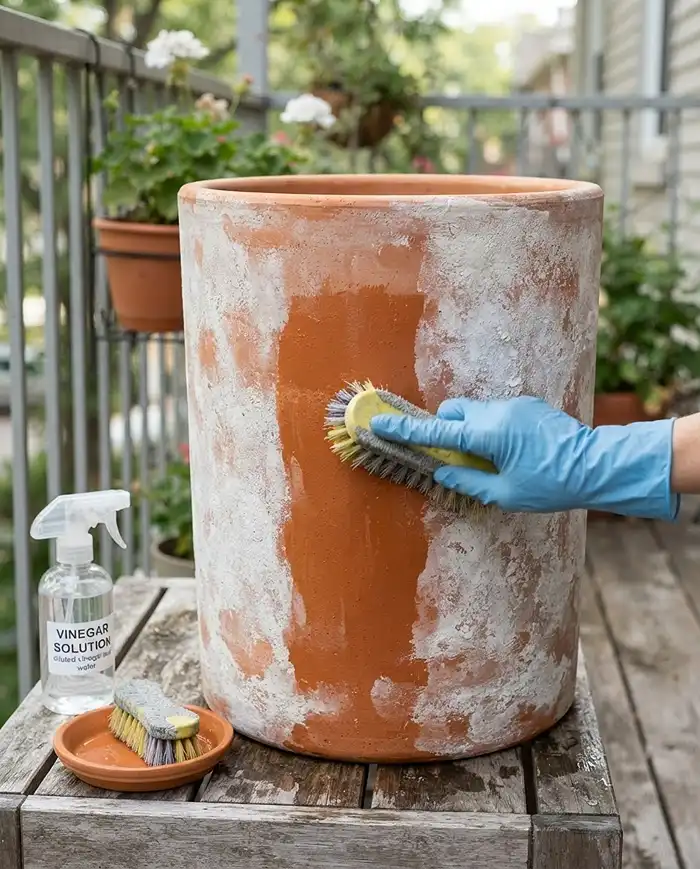
White Mineral Stains on Terracotta Pots
Quick Answer: White crust on terracotta is efflorescence — mineral salts from hard water and fertilizer migrating through the porous clay. Clean it with equal parts white vinegar and water, scrubbing with a stiff brush. Rinse thoroughly.
This is purely aesthetic and doesn’t harm the plant, but it disrupts the clean terracotta look you’ve built. I clean my pots once mid-season (usually July) and once before overwintering.
Switching to filtered or rainwater for irrigation significantly slows salt buildup. If you’re in a hard-water area like much of the UK or the American Southwest, this one change makes a visible difference within a season.
The RHS succulent growing guide covers mineral sensitivity in container plants and recommends similar low-mineral irrigation strategies for terracotta setups.
Drooping or Etiolated Plants
Quick Answer: Etiolation — stretching toward a light source — ruins the compact, geometric shape that makes minimalist plants work. Fix it by rotating each pot 90 degrees every week so all sides receive equal light exposure.
I caught this late with my jade plant in its second year. One side had grown nearly twice as tall as the other from reaching toward the balcony opening. It took a full season of weekly rotation plus corrective pruning to get the symmetry back.
If etiolation is severe, cut back to a balanced shape in early spring and rotate religiously from that point forward. Most plants recover fully within one growing season.
minimalist balcony garden ideas FAQs
How many pots should I use for a minimalist balcony?
Limit your design to three to five large-scale terracotta planters. Fewer, larger pieces create a sense of grandeur and open space. A dozen small pots will always look cluttered, no matter how carefully arranged.
Can terracotta pots survive freezing winters outside?
Unglazed terracotta is vulnerable to frost-heave — moisture inside the clay expands when it freezes, cracking the pot. In climates with hard freezes (below 25F), empty the pots, wrap them in bubble wrap or burlap, or move them indoors for winter.
What is the best potting soil to use with terracotta?
Use a premium organic potting mix blended with at least 30% perlite or pumice. Heavy garden topsoil will suffocate Mediterranean roots and dramatically increase the weight load on your balcony. Fast drainage is the priority.
Can I do a minimalist balcony garden in a shady spot?
Olive trees and most succulents need 6+ hours of direct sun. For north-facing or heavily shaded balconies, swap to shade-tolerant architectural plants like Aspidistra elatior or ferns in terracotta — but the olive green palette still works beautifully.
Is a small balcony garden worth the effort as a renter?
Yes — terracotta pots and plants move with you. A well-curated small balcony garden adds real value to daily life and requires no permanent modifications to the rental property. The rule of three pots makes setup and moving day easy.
Key Takeaways
- The best minimalist balcony garden ideas rely on constraint — a restricted palette of terracotta and olive green does more design work than any single plant or accessory.
- Use the rule of three: three to five large terracotta containers outperform a dozen small pots every time on a small balcony garden.
- Choose architectural plants — ‘Arbequina’ olive, Agave attenuata, Sansevieria — that hold their shape without constant maintenance or deadheading.
- Keep the central floor space empty; the void is what makes a small outdoor space feel expansive.
- Protect terracotta from frost-heave in cold climates and clean efflorescence mid-season to preserve the clean aesthetic that makes this balcony garden idea work year-round.