

23 Small Balcony Garden Ideas
These 23 small balcony garden ideas show how to turn wasted concrete into real growing space, even on a cramped 4×8-foot ledge. With the right layout, you can grow herbs, tomatoes, and trailing flowers in a compact space. Here’s how apartment gardening actually works in tight quarters.
I’ve grown food and flowers on balconies for nine years, first on a west-facing ledge in Chicago (zone 6a) and now on a fourth-floor, wind-whipped balcony in Denver (zone 5b). I’ve killed more basil than I’d like to admit, and I’ve also pulled 40 cherry tomatoes off a single ‘Micro Tom’ plant in a 10-inch pot.
Both experiences taught me something. Small balcony garden ideas only work if you match the plan to your actual space, not the Pinterest version of it.
Table of Contents
Assessing Your Balcony’s Unique Microclimate
Every balcony creates its own weather system. Concrete radiates heat, buildings block wind in one spot and funnel it in another, and reflected light from windows can scorch leaves that would be fine at ground level. Before you buy a single plant, spend a few days watching how your space actually behaves.
Success in a small balcony garden starts with observation, not shopping. My first year in Denver, I bought six tomato starts before realizing my “sunny” balcony only got four direct hours because of the building next door. I moved the pots eighteen inches and doubled my harvest.
Sunlight Tracking for Urban Spaces
Quick Answer: Track your balcony’s light every two hours for one full day, noting shadows from neighboring buildings and rooflines, then total the direct-sun hours to classify it as full sun (6+ hours), partial sun (4-6 hours), or shade (under 4 hours).
- Set a phone reminder every 2 hours from 8am to 8pm and snap a quick photo of the balcony floor
- Note the exact time direct sun disappears behind a neighboring roofline, since this shifts by season
- Track a weekday and a weekend, since building shadows change slightly with the sun’s seasonal angle
- Add up total direct-light hours, not just “bright” hours, since bright shade won’t ripen a tomato
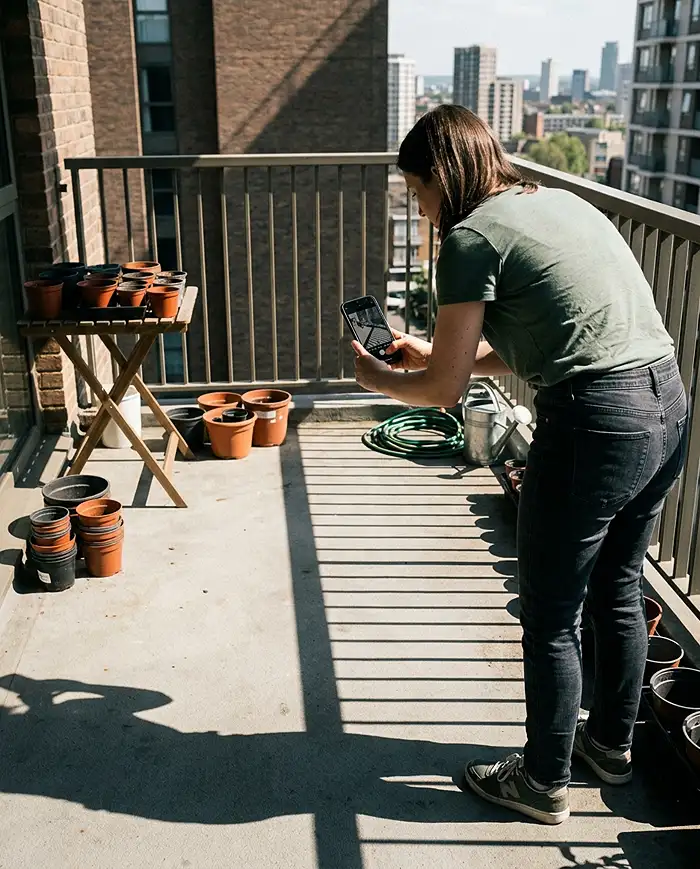
On my Chicago balcony, a rooftop AC unit cast a shadow I never noticed until I tracked it hourly. It cut my “full sun” corner down to five hours by July, which reclassified it as partial sun and changed which tomato variety I could actually grow.
Pro Tip: Reflected heat off glass or white siding can add the equivalent of an extra USDA zone of warmth, which is why succulents and Mediterranean herbs like rosemary often outperform their zone rating on a balcony.
Managing Wind Exposure and Weight Limits
Quick Answer: Calculate your balcony’s weight capacity by checking local building code (typically 50-100 lbs per square foot) and always verify with your landlord, since one large pot of wet potting soil can weigh 40-60 lbs before the plant is even added.
Wind matters just as much as weight, especially above the third floor. High-rise balconies create wind tunnel effects that snap stems and desiccate leaves faster than any ground-level garden.
- Group pots together in clusters rather than spacing them out, since neighboring plants block wind for each other
- Install windbreak netting on the railing, angled to cut wind speed without fully blocking airflow (full blockage causes turbulence)
- Choose sturdy, low-profile plants like sedum and ornamental grasses for the windiest corner, saving tall trellised plants for sheltered spots
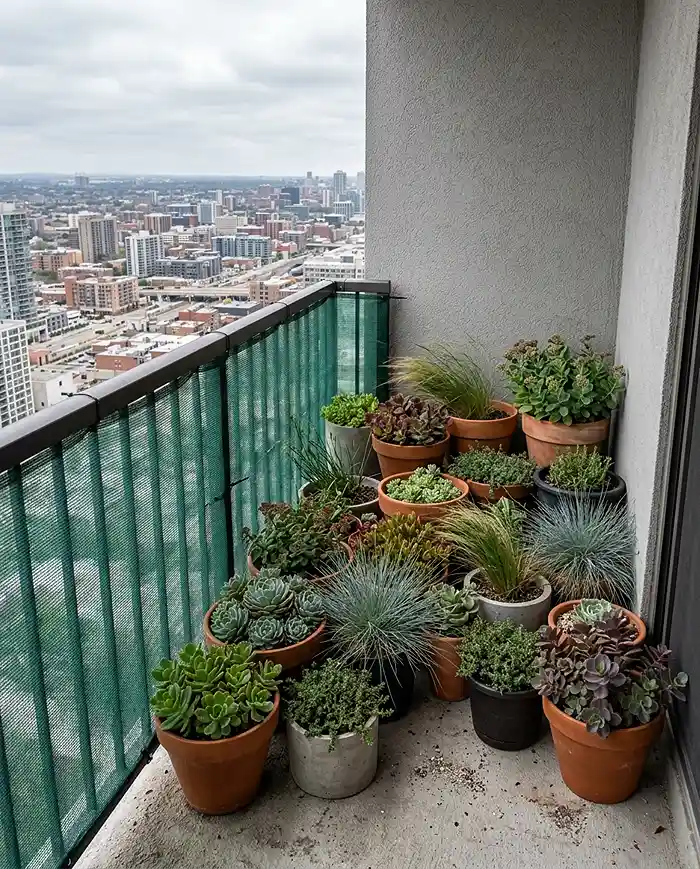
My eighth-floor balcony snapped three tomato stems in one May windstorm before I learned to cluster containers against the building wall instead of lining them along the railing. For more on working around building constraints, see this guide to apartment balcony garden ideas.
Essential Tools and Space-Saving Gear
Quick Answer: A compact balcony garden toolkit needs a collapsible watering can, a hand trowel with a narrow head, bypass pruners, a heavy-duty drop cloth for mess-free repotting, and a moisture meter to avoid overwatering in fast-draining pots.
- Collapsible 2-gallon watering can (stores flat in a closet, unlike rigid cans)
- Narrow soil scoop for tight container necks
- Bypass pruners for clean cuts that won’t crush stems
- Waterproof drop cloth (a $12 painter’s tarp works fine) for repotting without a mess on shared floors
- A cheap moisture meter, since finger-testing lies in fast-draining container mix
Pro Tip: Skip the full-size hose reel. A collapsible can forces you to actually check each pot individually, which catches drought stress before it kills anything.
Smart Design Strategies for Cramped Balconies
The trick to a small balcony garden that doesn’t feel cluttered is layering height instead of spreading everything across the floor. Draw the eye upward with trellises and hanging baskets, keep the floor mostly clear for walking, and use a repeating color palette so a jumble of pots reads as one cohesive design instead of a yard sale.
Maximizing Vertical Space
Quick Answer: Tension-rod plant poles, leaning ladder trellises, and railing-mounted planters let you grow upward without drilling into rental walls, typically adding 15-20 square feet of growing surface to a balcony with zero permanent damage.
- Tension rods (like a shower curtor rod, but rated for outdoor use) wedge between floor and ceiling for climbing vines
- Leaning ladder trellises rest against the railing or wall, no hardware needed, and fold flat for winter storage
- Railing-mounted planter boxes clip over the top rail, adding a full growing bed without touching the floor
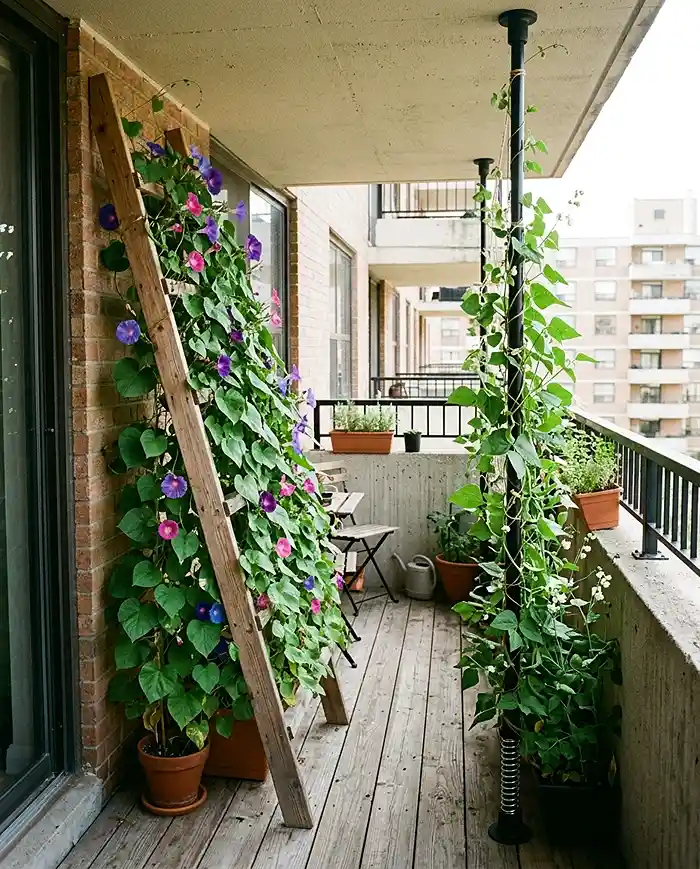
I installed a tension-rod pole for a ‘Heavenly Blue’ morning glory my second summer in Chicago, and it covered six feet of vertical space by August using a footprint smaller than a dinner plate.
Full setup instructions for renter-safe vertical gardens are in this renter-friendly patio garden guide.
Selecting the Best Containers
Quick Answer: Choose lightweight resin or fiberglass pots with non-negotiable drainage holes over heavy terracotta or concrete, and consider self-watering containers for balconies that bake in afternoon sun, since they cut watering frequency roughly in half.
| Container Type | Best For | Watch Out For |
|---|---|---|
| Fiberglass/resin | Weight-restricted balconies, most vegetables | Can crack in freezing temps if left full over winter |
| Self-watering | Hot, south-facing balconies, forgetful waterers | Reservoir can breed mosquitoes if not emptied after rain |
| Fabric grow bags | Root vegetables, tomatoes, seasonal storage | Dries out faster in wind, needs daily checks in July heat |
| Terracotta | Herbs that like drier roots, like rosemary | Heavy when wet, breaks weight budgets fast |
A self-watering fiberglass planter saved my basil during a July heatwave when I traveled for five days. The reservoir kept it alive while pots without one dried out and bolted within 48 hours.
Top Plant Choices for Apartment Balconies
Skip full-size garden varieties. Dwarf and container-bred cultivars are bred for confined root zones and consistently outperform standard varieties crammed into a small pot.
High-Yield Edibles: Herbs and Compact Vegetables
Quick Answer: ‘Micro Tom’ tomatoes, bush beans like ‘Provider,’ and shallow-rooted herbs (basil, thyme, chives) give the highest yield per square foot on a balcony, with most producing within 60-75 days of transplanting.
- ‘Micro Tom’ tomatoes: 8-inch pot minimum, fruits in 45-55 days, ideal for railings and hanging baskets
- Bush beans (‘Provider’ or ‘Contender’): direct-sow after last frost, harvest in 50-60 days, no trellis needed
- Basil (‘Genovese’ or Thai basil): pinch flower buds weekly to keep leaves coming all season
- Thyme and chives: perennial in most zones, tolerate the driest corner of the balcony
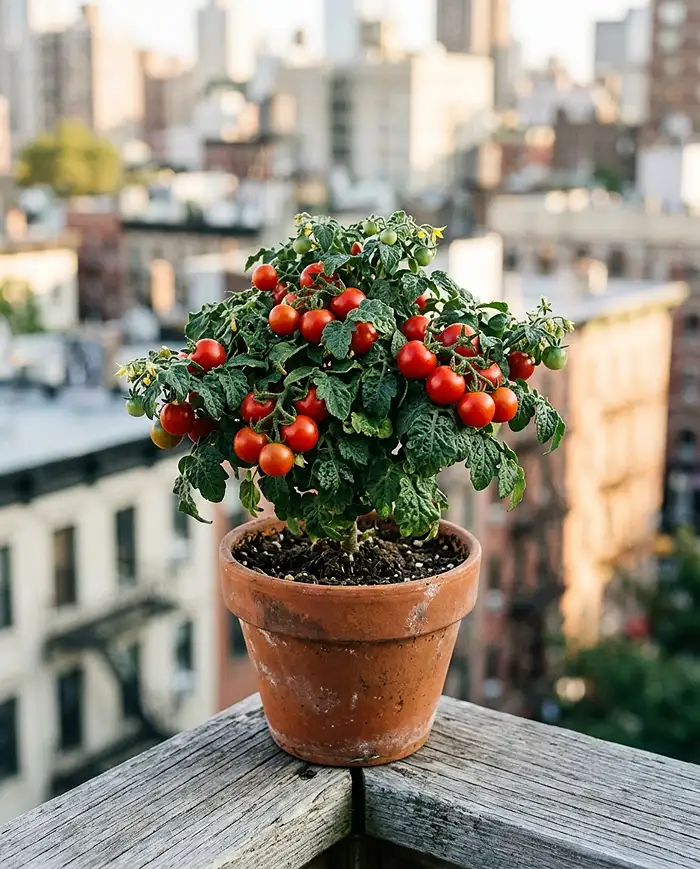
My ‘Micro Tom’ plants outproduced every full-size tomato I’d tried on that same balcony, largely because they’re bred to thrive in exactly the root-restricted conditions a container creates.
Creating Privacy with Ornamentals and Vines
Quick Answer: Mandevilla, star jasmine, and dense ornamental grasses like ‘Karl Foerster’ feather reed grass create a living privacy screen in pots, typically filling in within one growing season when given a trellis or railing to climb.
Star jasmine is my go-to for privacy since it tolerates the restricted soil volume of a 14-inch pot and still fills a trellis by midsummer. For color pairing ideas that work with these screening plants, check this balcony color palette guide.
Your Step-by-Step Balcony Makeover Action Plan
Here’s the weekend plan I use whenever I take over a new balcony, whether it’s a full renovation or a quick refresh for the season.
- Saturday morning: Sweep and pressure-wash (or hand-scrub) the floor, checking for cracks or standing-water spots that signal drainage problems
- Saturday afternoon: Install vertical infrastructure first, tension rods, trellises, railing planters, before any pots go down
- Saturday evening: Mix a lightweight custom potting medium: standard potting soil cut with 20-25% perlite or vermiculite by volume for drainage and weight savings
- Sunday morning: Place empty containers to test the layout and walking path before filling any of them with soil
- Sunday afternoon: Plant everything, then give a slow, deep first watering until water runs from the drainage holes
The University of Maryland Extension’s guide to container growing media is a solid reference if you want to understand exactly why straight garden soil fails in pots.
Seasonal Maintenance and Container Care
Container plants lose nutrients fast because every watering flushes some out through the drainage holes, a process called leaching. Feed most balcony plants with a diluted water-soluble fertilizer every 1-2 weeks during active growth, rather than the monthly schedule that works in garden beds.
For overwintering potted perennials, roots in above-ground containers freeze faster than roots in the ground. Cluster pots against the building wall, wrap containers in burlap or bubble wrap, and skip fertilizing entirely from October through February.
Common Problems and Solutions
Most balcony garden problems trace back to two things: fast-drying soil and pest outbreaks on stressed plants. Both are fixable once you catch them early.
Managing Fast-Drying Soil in Pots
Quick Answer: Hydrophobic (water-repelling) potting mix shows up as water pooling on top and running straight down the sides instead of soaking in. Fix it by bottom-watering, setting the pot in a tray of water for 20 minutes, and topping the soil with organic mulch to slow evaporation.
Wind and heat radiating off concrete dry balcony pots far faster than ground beds. Adding a one-inch mulch layer and mixing moisture-retaining polymer crystals into the top few inches of soil cuts watering frequency noticeably, especially on south-facing exposures.
Urban Pests: Spider Mites and Aphids
Quick Answer: Spider mites show up as fine webbing and stippled, dusty-looking leaves, while aphids cluster in soft clumps on new growth. Treat both with a neem oil spray every 5-7 days, or insecticidal soap for a faster knockdown on visible clusters.
Stressed, drought-hit plants attract mites first in my experience. The summer I let my mint dry out twice in one week, it was covered in webbing within four days. Consistent watering prevents more pest problems than any spray.
23 small balcony garden ideas FAQs
How much weight can a standard apartment balcony safely hold?
Most residential balconies are rated for 50-100 lbs per square foot under local building codes, but always verify your building’s specific limit with your landlord or property manager. Prioritize lightweight fiberglass or resin pots over heavy terracotta or concrete, and remember that wet potting soil alone can add 40-60 lbs per large container.
How do I water my balcony plants without dripping on my downstairs neighbors?
Use deep, sealed drip trays under every pot, choose self-watering containers where possible, and water slowly at soil level rather than from above so water soaks in instead of overflowing. Checking trays after heavy rain and emptying excess water also prevents overflow during storms.
What are the best plants for a fully shaded north-facing balcony?
Coleus, Heuchera, Boston ferns, and impatiens all thrive in low-light, container-friendly setups on north-facing balconies. Keep their soil evenly moist but never soggy, since shaded containers stay wet longer and are more prone to root rot than sun-exposed pots.
Can I grow vegetables on a balcony that only gets partial sun?
Yes, leafy greens, herbs like mint and chives, and root vegetables such as radishes tolerate 4-6 hours of direct sun and still produce well. Fruiting vegetables like tomatoes and peppers need closer to 6-8 hours for a reliable harvest.
How often should I fertilize container plants on a balcony?
Feed most actively growing balcony plants every 1-2 weeks with a diluted water-soluble fertilizer, since frequent watering leaches nutrients out of container soil much faster than in-ground beds. Cut back to no fertilizing during winter dormancy.
Conclusion
A thriving small balcony garden comes down to reading your specific microclimate, respecting your weight limits, and choosing plants bred for container life instead of fighting full-size varieties into cramped pots.
Start with one weekend, one wall of vertical growing space, and a few dwarf edibles. As of this growing season, that’s still the fastest path from bare concrete to a balcony you actually want to sit on.
Key Takeaways
- Track sunlight hourly for a full day before buying plants, since neighboring buildings distort true light exposure
- Confirm weight limits with your landlord and choose lightweight fiberglass or resin containers over terracotta
- Layer growing space vertically with tension rods and railing planters to keep the floor walkable
- Pick dwarf, container-bred cultivars like ‘Micro Tom’ tomatoes for the best yield in small pots
- These small balcony garden ideas work best when matched to your balcony’s actual sun, wind, and weight conditions, not a generic plan