
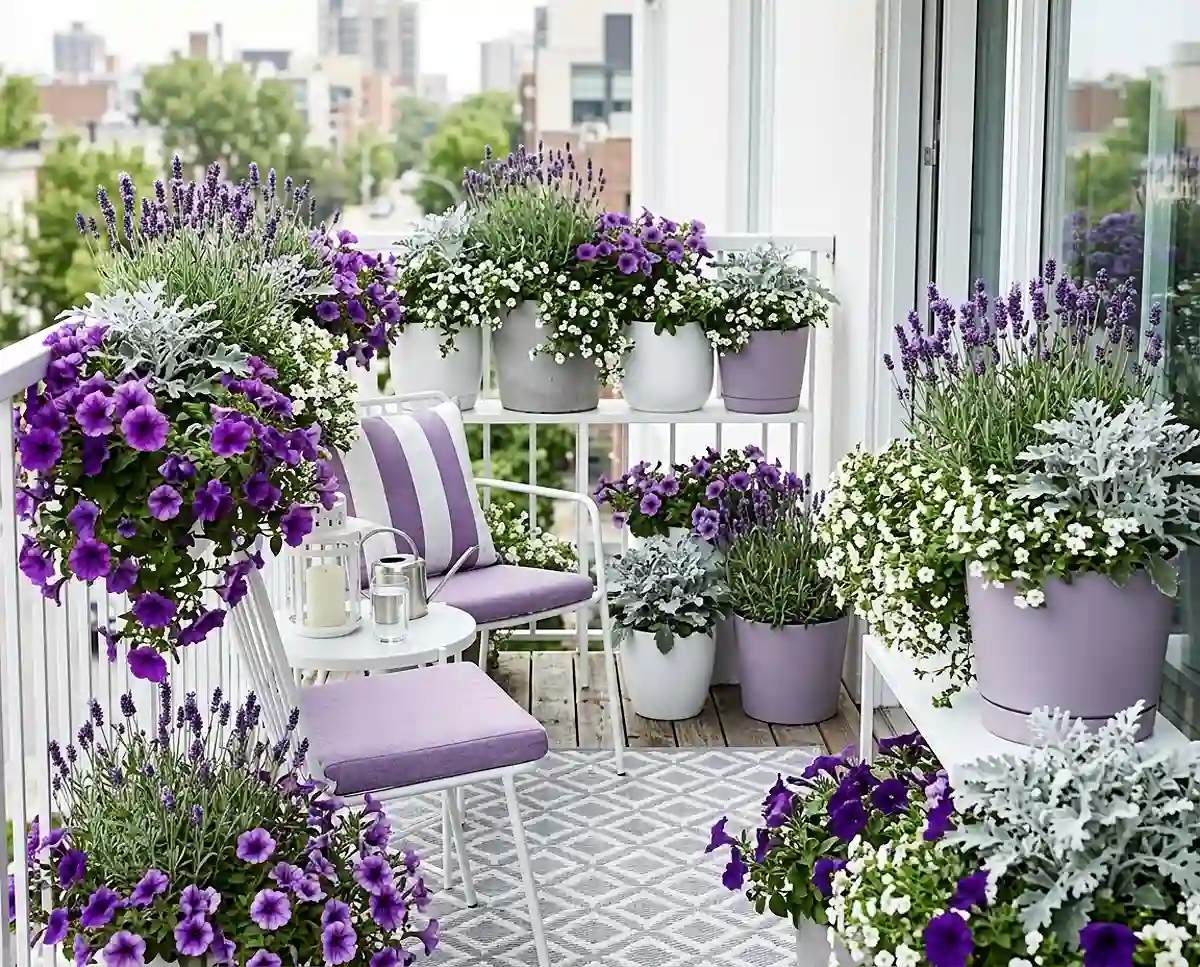
Small Balcony Color Palette Ideas With Plants
The right balcony color palette ideas with plants can turn even the tiniest outdoor space into somewhere you actually want to sit. Pick the wrong mix and it just looks cluttered.
This guide walks you through simple color theory, ready-to-copy schemes, and a step-by-step plan for your small balcony garden — so everything from your petunias to your pots works together.
Table of Contents
Why Color Palettes Transform a Small Balcony
A deliberate color scheme does something a random mix of plants never can: it creates visual calm. Your eye reads harmony instead of chaos, and the whole space feels intentional.
That matters even more on a small balcony. When colors fight each other, a tight space feels cramped. When they agree, even 40 square feet can feel like a proper garden retreat.
A unified palette also ties your plants and décor together. Your terracotta pots, your cushion covers, your trailing vines — they all start to belong to the same picture.
Think of it like an outfit. Individual pieces can be nice on their own, but a considered palette is what makes the whole thing look put together. That’s what good balcony garden ideas are built on.
Color Basics for Balcony Gardens
You don’t need a design degree here. A few simple color rules will get you most of the way. The goal is to understand how colors interact so you can make confident choices for your small balcony garden.
Understanding Warm vs. Cool Color Schemes
Quick Answer: Warm tones (red, orange, yellow) feel energetic and cozy. Cool tones (blue, purple, white, green) feel calm and spacious. Match the mood to how you use your balcony.
If you drink coffee out there in the morning and want to feel energized, go warm. If it’s your evening wind-down spot, cool tones will serve you better.
- Warm palette: Marigolds, geraniums, nasturtiums — vivid and cheerful, great for north-facing balconies that need a visual boost
- Cool palette: Lavender, petunias, white alyssum — airy and relaxing, ideal for sunny south-facing spots that already feel intense
- Neutral palette: Silvery foliage, white blooms, green only — works anywhere and never clashes with surrounding architecture
Pro Tip: If your building wall is a warm brick or terracotta color, cool-toned plants will contrast beautifully and stop the whole balcony from reading as one big orange blob.
How Color Affects the Feel of Small Spaces
Quick Answer: Light and cool colors visually expand a small balcony. Bold, dark colors shrink it — but used intentionally as a focal point, they add drama without overwhelming.
| Color Type | Visual Effect | Best Use |
|---|---|---|
| White / Pale pastels | Makes space feel larger | Background plants, wall planters |
| Cool blues / purples | Recedes, adds depth | Back of the arrangement |
| Bright reds / oranges | Advances, feels close | Single focal pot or railing box |
| Dark greens / burgundy | Grounds and anchors | Structural foliage plants |
Real Example: My 6 x 8 ft rental balcony felt like a corridor until I switched to an all-white and silver palette one spring. I planted white bacopa and Dusty Miller in a vertical garden shelf along one wall. It doubled the apparent depth of the space overnight.
Planning Your Balcony Color Palette
Before you buy a single plant, spend five minutes assessing your space. The best balcony color palette ideas with plants always start with what’s already there — light, surroundings, and existing colors.
Matching Colors to Light and Surroundings
Quick Answer: Check your sun exposure first, then look at your wall color and the view beyond. Your palette should complement all three — not fight them.
- Full sun (6+ hours): Most flowering plants thrive; bold warm colors look stunning
- Part shade (3–6 hours): Stick to white, yellow, and lime green blooms — they stay visible in lower light
- Full shade (<3 hours): Foliage is your palette — think variegated hostas, coleus, and ferns
- White or grey walls: Any palette works; cool tones feel especially elegant
- Brick or warm walls: Cool blues and purples create a striking contrast
Pro Tip: If your balcony overlooks greenery (a garden, park, or trees), treat that green as part of your palette. You don’t need to repeat it — just don’t clash with it.
Choosing a Two- or Three-Color Scheme
Quick Answer: Keep it to two or three colors max. One base, one accent, and one optional pop. More than that and the look becomes busy fast on a small balcony garden.
| Role | What It Does | Example |
|---|---|---|
| Base color | Dominates (~60% of plants) | White / green foliage |
| Accent color | Supports and repeats (~30%) | Soft purple |
| Pop color | One punchy focal point (~10%) | Deep violet or bright yellow |
Real Example: I once tried a four-color scheme — red, yellow, pink, purple — and it looked like a festival tent. Pulling back to white (base), lavender (accent), and one pot of deep burgundy (pop) transformed it.
Pro Tip: Repeat your accent color in at least three spots. The eye needs to see a color more than once before it reads as intentional, not accidental.
Best Balcony Color Palette Ideas With Plants
Here are three proven schemes you can copy directly. Each one works for apartment gardening where space is tight and every plant needs to earn its place.
Calm White and Green Palette
Quick Answer: White blooms plus varied green foliage. This palette is the most universally flattering for small balconies — it reads as fresh, clean, and spacious regardless of light levels.
- White Alyssum — fragrant, low-growing filler that spills over pot edges beautifully
- Bacopa ‘Snowflake’ — cascading trailer perfect for railing boxes
- Gardenia — bold scented blooms for a statement pot (USDA zones 8–11)
- Dusty Miller — silver-grey foliage that acts as a neutral bridge between greens
- Ferns or trailing Pothos — rich green foliage to anchor the arrangement
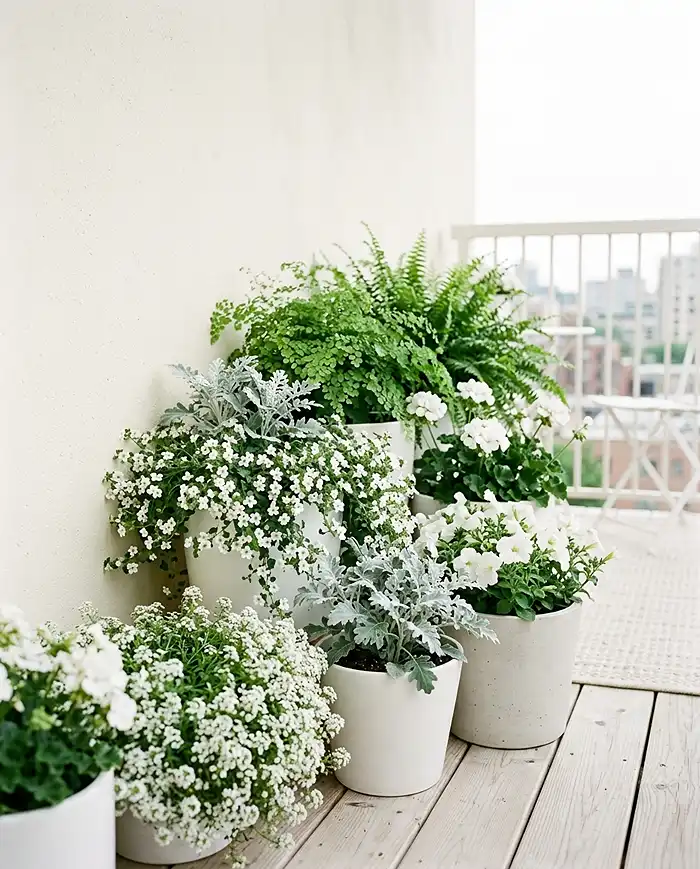
Real Example: I ran this scheme on a shaded east-facing balcony one summer. The white bacopa and Dusty Miller kept the space bright even on overcast days. Every guest commented on how “airy” it felt.
Pro Tip: Mix at least three different leaf textures within the green — fine, broad, and trailing — to prevent the palette from looking flat or monotonous.
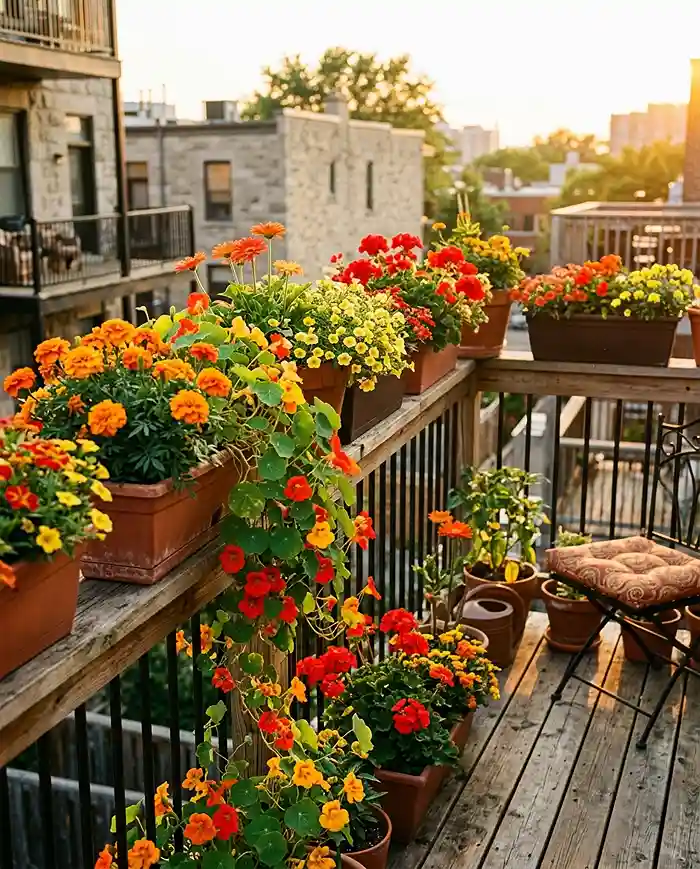
Warm Sunset Palette (Orange, Yellow, Red)
Quick Answer: Marigolds, nasturtiums, and red geraniums create a vibrant, cheerful balcony that feels welcoming from morning to evening. This is the go-to warm scheme for sunny small balcony gardens.
- French Marigolds — prolific bloomers from spring to frost; deadhead weekly for nonstop color
- Nasturtiums ‘Empress of India’ — trailing habit, edible flowers, dark foliage that contrasts orange blooms
- Geraniums ‘Caliente Orange’ — heat-tolerant and long-blooming, ideal for apartment gardening in warm climates
- Calibrachoa ‘Superbells Lemon Slice’ — yellow pop color that brightens the mix without clashing
For more on growing edible plants alongside your ornamentals, see this guide to edible balcony gardening.
Pro Tip: Keep orange as the base (60%), use yellow as the accent, and let red be your pop color in just one or two pots — otherwise this palette tips from “sunset” to “traffic cone.”
Cool Purple and Blue Palette
Quick Answer: Lavender, petunias, and salvia create a calming, elegant scheme that visually expands a small balcony. Cool tones recede, making the space feel deeper than it is.
- Lavender ‘Hidcote’ — compact, fragrant, drought-tolerant once established (zones 5–8)
- Wave Petunias ‘Easy Wave Blue’ — cascading, self-cleaning, reliable color all season
- Salvia ‘Evolution Violet’ — upright spikes that add height and structure
- Lobelia ‘Sapphire’ — delicate trailer that softens pot edges with true-blue flowers
Real Example: I planted this scheme on a west-facing balcony in summer. By July, the salvia spikes were 18 inches tall and the lobelia was tumbling 12 inches over the railing box. It looked like a waterfall of purple.
Pro Tip: Add one pot of white or silver foliage (Dusty Miller or white salvia) to give the purple and blue room to breathe — without it, the palette can feel heavy.
Coordinating Plants With Pots and Décor
Good balcony color palette ideas with plants don’t stop at the blooms. Your planters, cushions, and accessories are part of the picture — coordinate them and the whole space lifts a level.
Choosing Planters That Match or Contrast
Quick Answer: Match pots to your base color for a calm, unified look. Contrast them with your pop color for a bold, graphic effect. Both work — just commit to one approach.
- Matching: White pots with white-and-green palette — serene and timeless
- Contrasting: Deep navy pots with a warm orange palette — bold and modern
- Neutral terracotta: Works with warm palettes; can clash with cool ones — test before buying
- Black pots: Ground any palette; make colors pop; great for a moody, contemporary look
If you’re worrying about soil moisture in summer, this tip on keeping pots moist in summer heat is worth reading — lighter-colored pots help here too.
Pro Tip: Use odd numbers of pots (3, 5, 7) and vary their heights. Visually, odd numbers feel more dynamic and natural than even groupings.
Cushions, Rugs, and Accents That Tie It Together
Quick Answer: Pull one color from your plant palette and repeat it in your textiles. You don’t need to match exactly — just stay within the same color family.
- Outdoor rug in your base color or a neutral (jute, grey, navy) grounds the whole space
- Cushions in your accent color tie seating into the plant scheme without looking forced
- String lights add warmth without color — safe for any palette, especially cool or neutral schemes
- One or two metallic accents (copper, brass, or matte black) add sophistication without competing
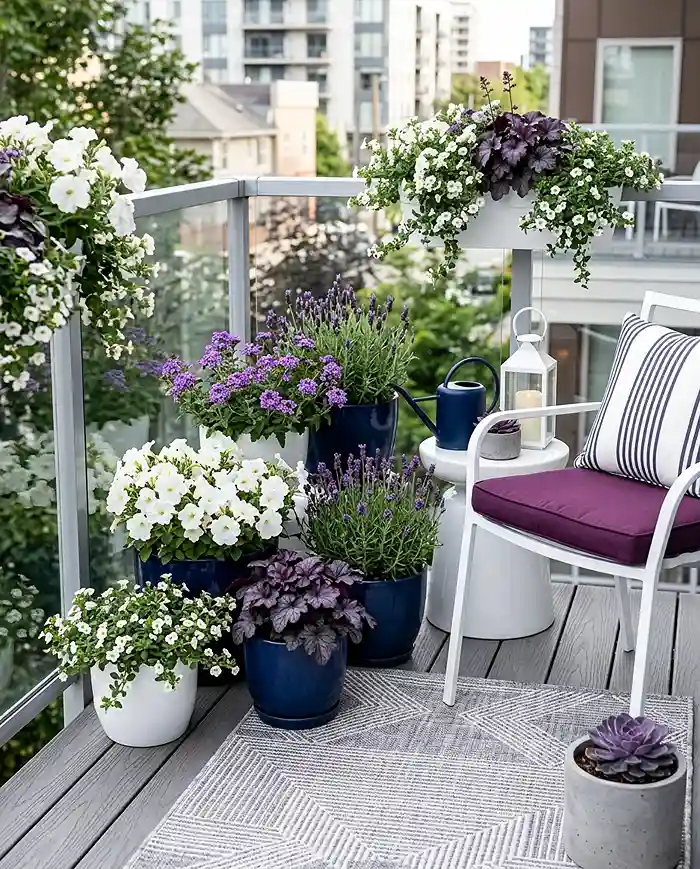
Real Example: For my purple and blue balcony, I found a grey outdoor rug and two deep plum cushions. Total cost: $35 at a discount store. The balcony went from “nice plants” to a proper outdoor room.
Pro Tip: Avoid printed textiles with multiple colors — they’ll fight your carefully chosen plant palette. Stick to solid colors or simple textures.
Tools and Materials You’ll Need
Before you start building your color-themed small balcony garden, gather these basics:
- Plants: Choose varieties suited to your light conditions; buy in odd numbers for visual rhythm
- Planters: 1–3 sizes for height variation; ensure drainage holes in every pot
- Potting mix: Use a quality container mix with perlite — never garden soil, which compacts and drains poorly
- Slow-release fertilizer: Osmocote or similar; mix into potting soil at planting for season-long feeding
- Railing planters: For small balconies with no floor space to spare
- Watering can or drip system: Containers dry out fast — daily watering is often needed in summer
- Basic hand tools: Trowel, pruners, and gloves cover 90% of container gardening tasks
Step-by-Step: Building Your Color-Themed Balcony
Ready to put it all together? Follow this sequence for a cohesive result the first time.
Layering Plants by Color and Height
Quick Answer: Arrange plants from tallest at the back to shortest at the front. Distribute your accent color in at least three spots so the eye travels around the space.
- Set your tallest plants first — these are your structural anchors (grasses, salvia, geraniums). Place them at the back or in corners.
- Add mid-height plants in the center — compact bloomers like marigolds or lavender fill the middle tier.
- Place trailers and fillers at edges — bacopa, lobelia, and nasturtiums spill over pot rims and soften hard lines.
- Step back and check color distribution — your accent color should appear in at least three separate spots, not clumped in one area.
- Fill gaps with foliage — green or silver leaves between blooms give the eye a rest and make colors pop harder.
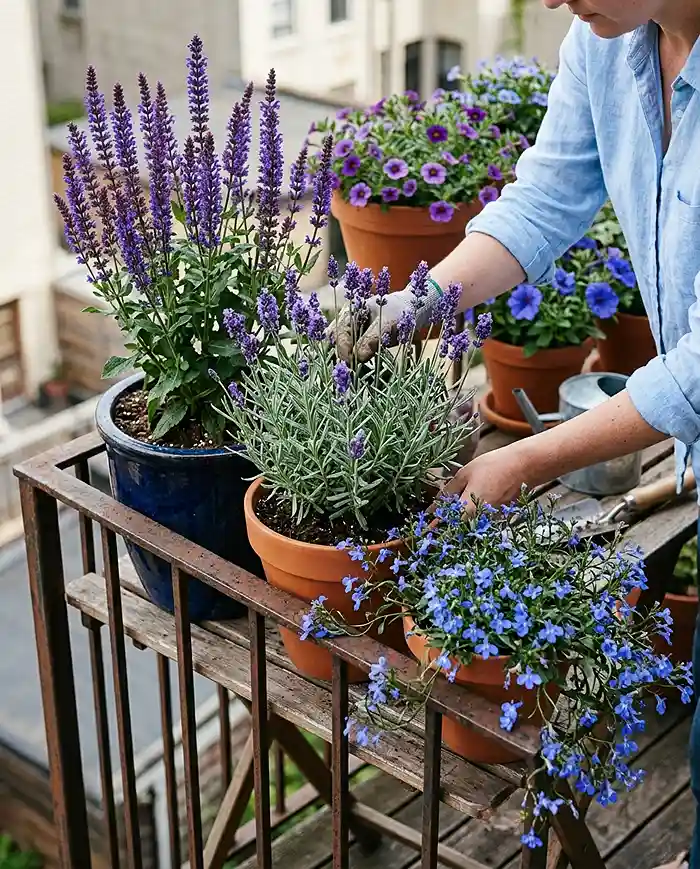
Pro Tip: Photograph your arrangement from your seating position before you finalize anything. What looks good standing over the pots often reads very differently from where you’ll actually be sitting.
Adding Décor and Finishing Accents
Quick Answer: Layer in your textiles and lighting after plants are placed. Décor should support the palette, not compete with it.
- Lay your outdoor rug first — it anchors the floor and sets the spatial boundary
- Position seating, then add cushions in your accent color
- Hang string lights or a wall sconce — warm white bulbs suit any palette
- Add one decorative object max (lantern, mirror, or small sculpture) — more than one starts to feel cluttered on a small balcony
- Step back from outside the balcony door and assess the whole picture
If vertical space is tight, a tiered vertical garden shelf lets you display more plants without sacrificing floor space.
Caring for Your Color-Themed Plants
A beautiful palette only stays beautiful with consistent care. Container plants need more attention than in-ground ones — they can’t draw on surrounding soil reserves. This applies to all balcony garden ideas, regardless of the scheme you choose.
Watering, Feeding, and Deadheading for Color
Quick Answer: Water deeply and consistently. Feed every two weeks during the growing season. Deadhead [remove spent flowers] weekly to keep plants blooming instead of going to seed.
- Watering: Check soil daily in summer — most containers need water every 1–2 days when temps exceed 80°F
- Feeding: Liquid fertilizer (10-10-10 or bloom formula) every 14 days once plants are established
- Deadheading: Pinch or snip faded flowers at the stem base; this redirects energy to new blooms
- Geraniums: Remove entire spent flower clusters — just pulling petals leaves a stem that rots
- Marigolds: Deadhead every 5–7 days; they’ll bloom continuously from spring to frost
Pro Tip: Do a quick five-minute “tidy pass” every morning while you have your coffee. Catching problems early — yellowing leaves, pests, wilting — prevents small issues from becoming palette-wrecking disasters.
Keeping Foliage and Pots Looking Fresh
Quick Answer: Wipe dusty leaves with a damp cloth monthly. Scrub any algae or mineral deposits off pot exteriors every 6–8 weeks to keep your coordinated look crisp.
- Dusty or grimy leaves block light and reduce photosynthesis — a wipe-down also lets you spot pests early
- White calcium deposits on terracotta can be removed with a diluted white vinegar solution (1:1 with water)
- Algae on pot sides signals overwatering or poor drainage — fix the root cause, then scrub with a stiff brush
- Replace any pot that cracks — they’re hard to disguise and pull the eye away from your plants
Pro Tip: A quick spray of diluted neem oil on foliage every few weeks keeps common pests like aphids and spider mites under control before they become a problem.
Seasonal Color Rotation
One of the best things about apartment gardening in containers is how easy it is to refresh your palette as seasons shift. You’re not digging anything up — just swapping pots.
Swapping Seasonal Blooms to Keep Color Year-Round
Quick Answer: Choose one or two anchor plants that stay year-round (lavender, ornamental grasses, evergreen foliage), then rotate seasonal bloomers in and out around them.
- Spring: Pansies, violas, tulip bulbs, and sweet alyssum — cool-season plants that fade when summer heat arrives
- Summer: Petunias, marigolds, geraniums, lobelia — peak color season for most balcony garden ideas
- Fall: Ornamental kale, mums, sedums, and late asters — swap in as summer annuals decline (usually September)
- Winter (zones 7–10): Cyclamen, winter pansies, and evergreen foliage plants; in colder zones, bring tender perennials indoors
Real Example: I keep two large pots of lavender as permanent anchors in my purple scheme. Every season I change what’s around them — tulips in spring, petunias in summer, purple kale in fall. The palette stays consistent; the look feels fresh.
Pro Tip: Buy seasonal replacement plants in the same color family as your base scheme. It takes two minutes of planning at the garden center and prevents impulse buys that break your palette.
Common Problems and Solutions
Even the best-planned small balcony garden runs into issues. Here’s how to fix the most common ones without starting over.
The Palette Looks Mismatched or Busy
Quick Answer: You’ve got too many colors competing. Remove the outliers and repeat your base tone two or three more times — repetition is what creates cohesion.
- Pull out any plant that doesn’t belong to your two- or three-color scheme
- Add more of your base color to overwhelm the chaos visually
- Introduce a unifying foliage plant (Dusty Miller, sweet potato vine ‘Tricolor’) to bridge clashing hues
Faded or Sparse Blooms
Quick Answer: Usually a light, feeding, or deadheading issue. Check all three before assuming the plant is failing.
- Insufficient light: Move sun-loving plants to the sunniest spot; replace with shade-tolerant alternatives if moving isn’t possible
- Underfeeding: Start fortnightly liquid fertilizer if you haven’t been feeding at all
- Skipping deadheading: Remove all spent blooms this week — you’ll often see new buds within days
Colors Looking Dull in Low Light
Quick Answer: Choose brighter, lighter-toned blooms and use white or pale-colored pots. Both reflect available light and keep the palette vibrant in shady conditions.
- Replace deep-colored flowers with white, yellow, or lime green varieties that glow in shade
- Use white, cream, or pale grey pots to bounce light back onto foliage
- Add Torenia (Wishbone Flower) and Impatiens — they’re designed for low-light color
- Consider adding a small mirror to reflect more natural light across the space
Frequently Asked Questions
How do I choose a color scheme for my balcony?
Start with your light conditions, then look at your wall color and surroundings. Pick two colors you love that work in your light level, add a neutral (white or green foliage) as a base, and limit yourself to three colors max for a cohesive small balcony garden.
What flower colors make a small balcony look bigger?
White, pale pastels, and cool tones like lavender and soft blue visually expand a small balcony. These colors recede rather than advance, making the space feel deeper. Avoid massing bold reds or oranges, which visually shrink a space.
How many plant colors should I use on a small balcony?
Stick to two or three colors for a cohesive look. One base color (about 60% of plants), one accent color (about 30%), and one optional pop color (10%) is the simplest formula that works every time for apartment gardening.
Can I use balcony color palette ideas with plants in full shade?
Yes. Focus on foliage color rather than blooms — variegated hostas, coleus, and ferns offer a full palette in shade. For flowers, choose white impatiens, torenia, or begonias, which hold color better in low light than most other bloomers.
How do I keep my color palette looking good all season?
Deadhead spent flowers weekly, feed with liquid fertilizer every two weeks, and water consistently. When summer annuals fade, swap them for fall bloomers in the same color family to maintain the scheme through the season change.
Key Takeaways
- The best balcony color palette ideas with plants use two to three colors max — one base, one accent, one pop
- Cool and light tones visually expand a small balcony garden; warm, bold tones create energy and focal drama
- Extend your palette beyond plants to pots, cushions, and rugs for a fully designed outdoor space
- Deadhead weekly, feed every two weeks, and rotate seasonal bloomers to keep your palette vibrant all year
- When the look feels busy, simplify — remove outliers and repeat your base color until cohesion clicks