
Growing Strawberries on Balcony: 14 Ideas That Work
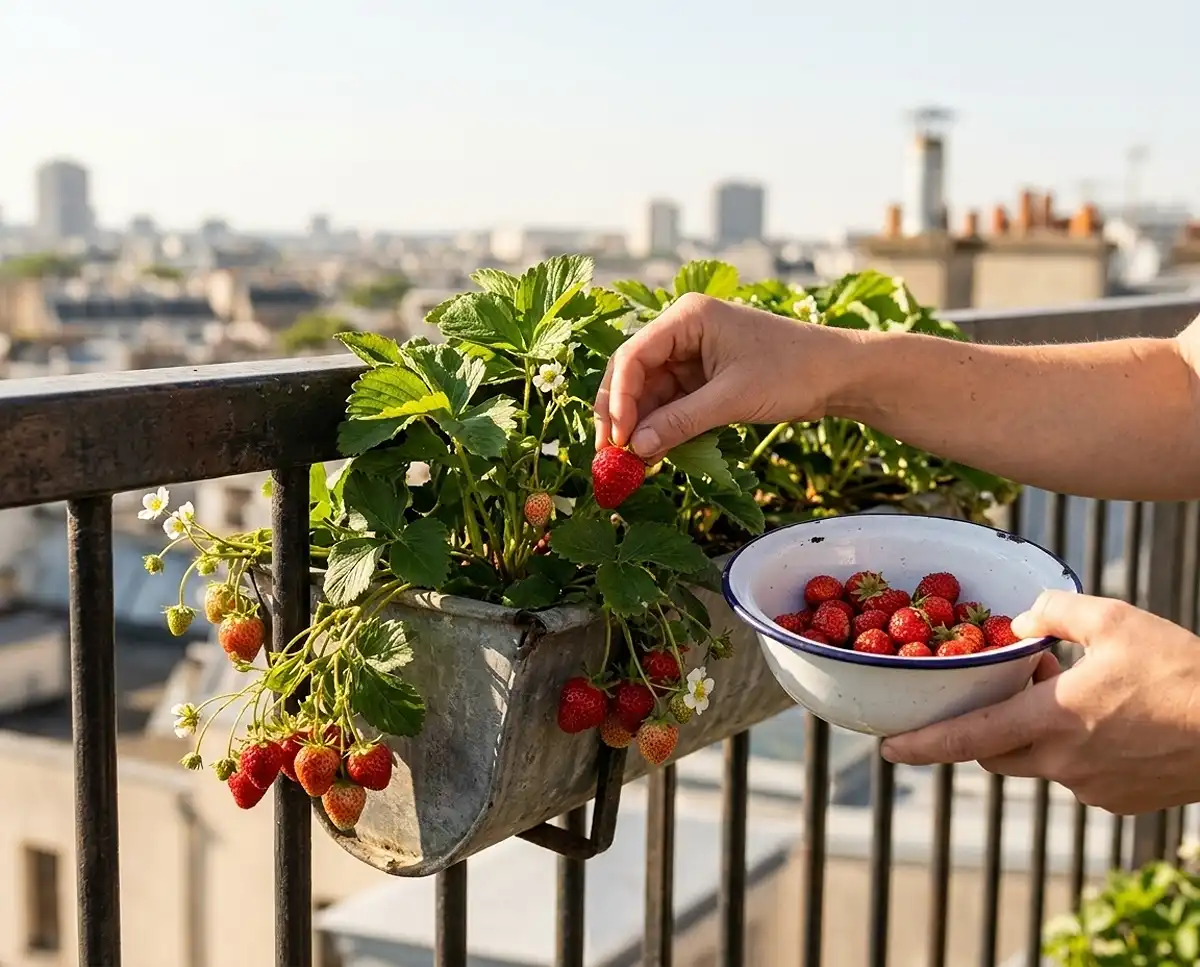
Growing strawberries on balcony rails felt impossible until I found the right balcony strawberry planters. Now my rooftop terrace in zone 7a feeds me berries from late May to October. Here’s what worked, what flopped, and how to copy it.
Quick setup note, so you know where this advice comes from. My terrace gets about eight hours of direct sun, and our average last frost lands in mid-April. I’ve grown berries in fabric bags, towers, rail boxes, and thrifted pots.
Table of Contents
Growing Strawberries on Balcony Space: Varieties, Sun, and Weight Limits
Short Answer: Strawberries have shallow roots, so they thrive in pots, rails, and towers. Variety decides your harvest window. June-bearing plants fruit for about three weeks, while day-neutral types fruit from late spring until frost. Pick day-neutral for steady berries, and give them six hours of sun.
As of the 2026 season, ‘Albion’ and ‘Seascape’ are still my favorite day-neutral [plants that flower regardless of day length] picks. Both are hardy in zones 4 to 9 and fruit roughly 12 weeks after planting.
Day-Neutral vs. Everbearing vs. June-Bearing vs. Alpine Strawberries for Pots
Short Answer: Day-neutral strawberries give the most fruit per square foot in containers because they flower all season. June-bearers deliver one big flush. Everbearers give two or three smaller flushes. Alpine strawberries are runnerless, shade-tolerant, and tiny but intensely flavored, so they suit dim corners.
Here’s the quick comparison I wish I’d had in my first year.
| Type | Harvest window | Best for | Cultivars to try |
|---|---|---|---|
| Day-neutral | Late spring to frost | Highest yield in pots | ‘Albion’, ‘Seascape’, ‘Mara des Bois’ |
| Everbearing | Two or three flushes | Steady, modest picking | ‘Ozark Beauty’ |
| June-bearing | About three weeks in June | One big jam batch | ‘Earliglow’ |
| Alpine | Early summer to fall | Shade (3 to 4 hours of sun) | ‘Alexandria’, ‘Yellow Wonder’ |
Alpine types send out no runners [long stems that root into baby plants], so they stay tidy in a bowl. Birds also ignore the pale ‘Yellow Wonder’ berries.
Mapping Sunlight Hours, Pollination Airflow, and Railing Weight Limits
Short Answer: Look for six or more hours of direct sun, or four for alpines. A gentle breeze moves pollen between flowers. Keep weight low: wet potting mix weighs roughly 5 to 6 pounds per gallon, so check your railing’s load limit first.
Sugar builds in the sun. Fewer than six hours gives pale, sour fruit. Strawberry flowers are self-fertile [each flower can pollinate itself], but a breeze shakes the pollen loose.
- Check your balcony at 9 a.m., noon, and 3 p.m. on a clear day.
- Count only direct light, not bright shade.
- Skip glass-sealed corners where air never moves.
- Ask your building manager about railing load limits.
Essential Prep: Shallow Containers, Acidic Soil Mix, and Crown-Planting Rules
Short Answer: Strawberries need containers at least 6 to 8 inches deep, drainage holes, and light-colored sides to keep roots cool. Use a slightly acidic, fast-draining mix and plant each crown flush with the soil line. Get those three right and you’ll avoid most early losses.
The crown [the fleshy base where leaves meet roots] is the part that makes or breaks your first season. Start with the right pot.
- Depth of 6 to 8 inches, minimum.
- Long, narrow boxes beat round pots, according to UW-Madison Extension’s container strawberry guide. Round pots should be at least 12 inches wide.
- Drainage holes, with no attached saucers holding water.
- Light-colored sides, because dark pots cook roots in July.
Choosing Pocket Jars, Stackable Towers, and the “Goldilocks” Crown Depth Rule
Short Answer: Strawberry roots only need 6 to 8 inches of depth, so pocket jars, towers, and shallow troughs all work. The key is crown depth. Set the fleshy crown exactly level with the soil: roots buried, growth point open to air. Too deep rots it; too high dries it.

One cold March, I buried ten bare-root ‘Albion’ crowns up to their leaf bases in a 12-inch pot. Soil sat near 45°F. Six crowns rotted by May.
The next spring, I fanned the roots over a small soil cone and set each crown flush with the surface. I lost zero. Now I check crown height again after the first heavy watering, because soil settles.
The Slightly Acidic, Fast-Draining Strawberry Potting Soil Recipe (pH 5.5-6.5)
Short Answer: Blend 35% peat-free coco coir, 30% aged pine bark fines, 25% perlite, and 10% worm castings. Add organic 4-6-4 berry fertilizer at the label rate. It drains fast, holds even moisture, and settles near pH 5.5 to 6.5 for sweet berries.
| Ingredient | Share | Its job |
|---|---|---|
| Peat-free coco coir | 35% | Holds steady moisture |
| Aged pine bark fines [finely shredded composted bark] | 30% | Gentle acidity and airflow |
| Perlite [puffed volcanic glass] | 25% | Fast drainage |
| Worm castings | 10% | Gentle nutrients |
The same airy-mix logic helps tomatoes too. I walk through it in my guide to growing tomatoes on a balcony.
14 Strawberry Balcony Garden Ideas Worth Making Room For
Short Answer: These 14 setups use rails, walls, ceilings, and towers so berries fit even on a 4-foot balcony. Match each idea to your sun hours and weight limits, then start with one or two. Most hold day-neutral plants, so you’ll pick berries from June to frost.
Each idea below gives you a plant, a size, and one trick that saved me trouble.
Idea 1: Stackable 5-Tier Rotating Strawberry Tower on a Wheeled Drip Base
Short Answer: A five-tier clover-leaf tower holds 20 day-neutral ‘Albion’ plants in an 18-inch floor footprint. A perforated PVC pipe down the center sends water to every tier. Put the base on wheels so you can rotate it toward the sun every few days.
My first full summer, one tower gave me about 18 quarts between June and October. The top tiers dry fastest, so I water those first.
Idea 2: Over-the-Rail Saddle Troughs of Cascading ‘Mara des Bois’ Gourmet Berries
Short Answer: Dual-sided railing planters let ‘Mara des Bois’ [a French everbearing hybrid with a wild-strawberry aroma] drape over the edge. Berries hang in open air, so they stay clean, dry, and mostly slug-free. Choose saddle troughs rated for wet soil, and anchor them with straps.
If rail space is all you have, these are the best balcony strawberry planters I know.
Idea 3: Ceiling-Hung Coco-Coir Baskets of Pink-Flowering ‘Tristan’ or ‘Toscana’ Strawberries
Short Answer: ‘Tristan’ and ‘Toscana’ are ornamental-edible hybrids with hot-pink to magenta blossoms. Hang them in 12-inch coco-coir baskets from overhead hooks, and the stems cascade about 24 inches. You get flowers first, then sweet berries, all from one pretty basket that earns its hook.
Baskets dry fast in wind. Check them daily in July.

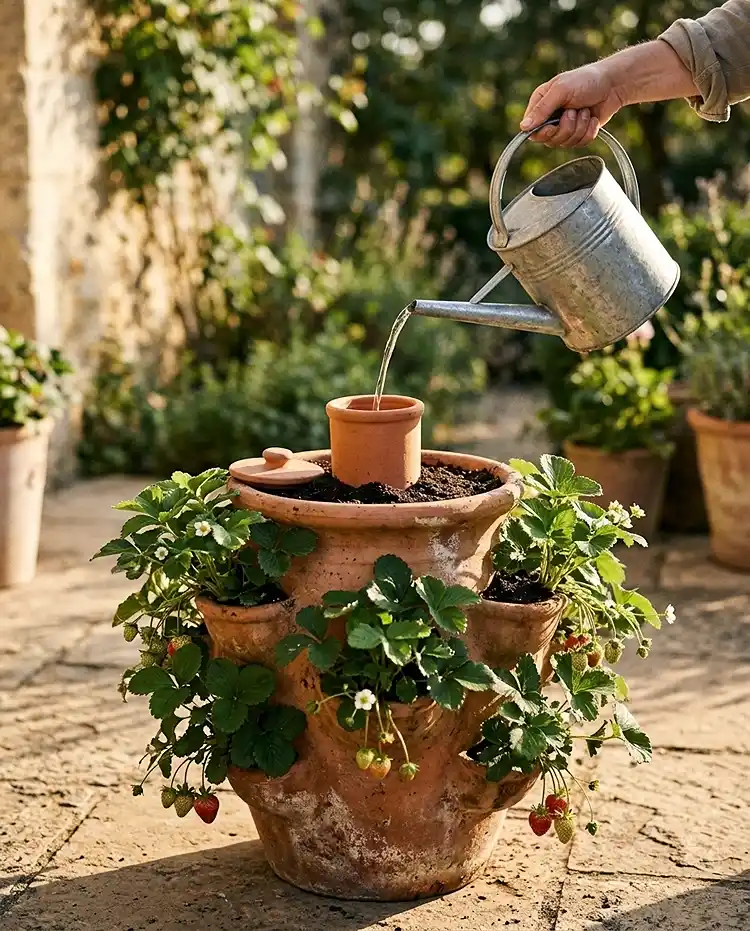
Idea 4: Classic Terracotta Multi-Pocket Strawberry Urn with a Central Olla Core
Short Answer: Side-pocket urns dry out at the top first. Bury a capped, unglazed terracotta pipe down the center as an olla [a clay water reservoir that seeps slowly]. Fill it with water, and every pocket stays evenly damp. Soak the clay for an hour before planting.
Plant one crown per pocket and fill the olla every two or three days in summer.
Idea 5: Wall-Mounted Vinyl Rain-Gutter Tiers for Zero-Floor-Space Harvesting
Short Answer: Hang three 36-inch lengths of 5-inch vinyl rain gutter on a sunny brick wall or wooden privacy screen. Strawberries’ shallow, fibrous roots fit the gutter depth perfectly. Drill drainage holes every six inches, add end caps, and you’ve got a harvest wall with zero floor space used.
Space the tiers 10 inches apart so each row gets light.
Idea 6: Shady North-Balcony Woodland Bowl of Red and Yellow Alpine Strawberries
Short Answer: Runnerless alpine strawberries (Fragaria vesca) fruit nonstop on just 3 to 4 hours of gentle sun. Pair red ‘Alexandria’ with ivory ‘Yellow Wonder’ in a 12-inch bowl. Birds ignore the yellow berries, so you’ll often get them all to yourself.
My shadiest corner gave me about 15 tiny, perfumed berries a week from June to October.

Idea 7: Breathable Side-Slit 10-Gallon Fabric Grow Bag “Berry Pillar”
Short Answer: A pre-slit felt strawberry grow bag gives you 12 side pockets plus an open top. The fabric air-prunes roots [roots stop circling and branch instead when they meet air]. Set the bag on a sturdy stand or heavy-duty wall bracket, never a flimsy rail.
A wet 10-gallon bag can weigh over 50 pounds. Check your floor and bracket ratings first.

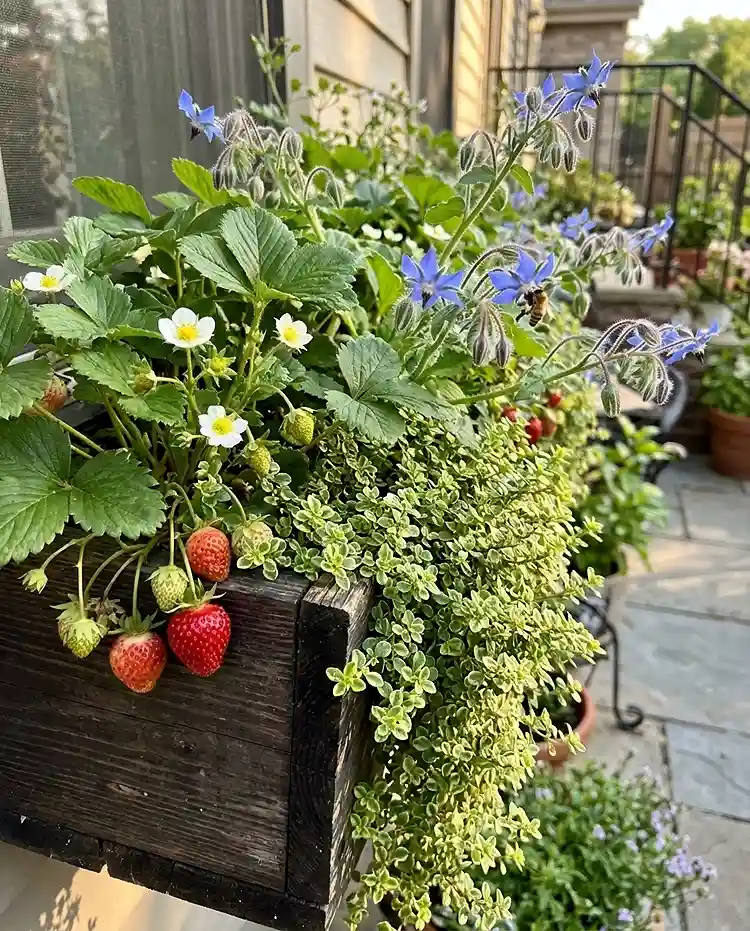
Idea 8: The “Borage, Thyme, and Berry” Companion Window Box for Maximum Pollination
Short Answer: Combine ‘Seascape’ strawberries with blue, star-shaped borage and creeping lemon thyme in a deep window box. The flowers lure high-rise bees, which improves pollination and berry shape. Borage self-seeds freely, so snip spent blooms if you want to keep it contained.
Last summer, eight ‘Seascape’ plants in a 30-inch box gave me about eight quarts between June and October. Bees found it within a week.
Idea 9: Upcycled Stepped Cedar Crate Ladder with Runner-Propagating Nursery Pots
Short Answer: A three-tier wooden ladder stand lets mother plants on the top shelf send runners down to root in 4-inch pots waiting below. Pin each runner into the soil with a hairpin. In three to four weeks, you’ll have free baby plants ready to snip and replant.
Let only two runners per mother plant root, and do it after the main harvest.

Idea 10: Underplanting Dwarf Patio Fruit Trees or Blueberries with a Strawberry “Living Mulch”
Short Answer: Tuck shallow-rooted strawberries around the base of a 15-gallon potted ‘Top Hat’ blueberry. They share the same acidic soil, and the leaves shade the blueberry’s roots. Aim for a pH near 5.5, where both plants stay happy. Add a thin layer of mulch on top to hold moisture.
Keep the strawberries a hand’s width from the trunk so roots don’t fight.

Idea 11: Breathable Over-the-Door Canvas Pocket Wall on a Sunny Utility Closet
Short Answer: Line a 12-pocket felt wall organizer with perforated plastic inserts, then hang it on a sunny closet door or wall. Each pocket holds one strawberry plant. Add chives and baby lettuce in the lower pockets and you’ve got a vertical berry curtain in a narrow doorway.
Water from the top with a squeeze bottle, and let the extra drain into a tray.
Idea 12: Hanging Upcycled Colander Trio Painted in Pastel Cottage Colors
Short Answer: Line three thrifted 10-inch metal colanders with sphagnum moss, paint them pastel, and hang them at staggered heights from a tension rod. Colanders drain perfectly on their own. Choose stainless or powder-coated ones so rust never stains your balcony floor.
They dry out fast, so check them daily in hot weather.
Idea 13: The “Salad & Caprese” Edible Bistro Centerpiece with Baby Spinach and Garlic Chives
Short Answer: Pair compact day-neutral strawberries with baby spinach and garlic chives in a wide, shallow 14-inch glazed tabletop bowl. The chives help repel pests, and the spinach fills gaps between plants. Drill a drainage hole in the bowl first, using a ceramic bit.
It’s a lovely centerpiece for a small balcony kitchen garden, and dinner is right there.

Idea 14: Cold-Frame Wooden Box Planter for Ultra-Early April and Late November Berries
Short Answer: Add a removable clear polycarbonate cold-frame lid over a rectangular cedar trough. It warms spring crowns about four weeks early and keeps plants fruiting past the first frost. Prop the lid open on days above 70°F so the box doesn’t overheat.
In zone 7a, mine delivers the first ripe berries in April and the last in late November.
Mastering Balcony Strawberry Care: Pinching, Feeding, and Overwintering
Short Answer: Pinch early flowers on new plants so roots grow strong. Snip extra runners so energy goes into fruit. Feed every 14 days with a potassium-rich liquid fertilizer, mulch under ripening berries, and shelter pots against a wall before hard freezes. These habits double berry size and keep crowns alive.
Strawberries are forgiving, but they reward a simple routine. Here’s the one I follow.
Pinching Early Blossoms, Snipping Runners, and the Bi-Weekly High-Potash Feeding Chart
Short Answer: Pinch every flower for the first four weeks on newly planted bare-root crowns. That builds a big root system. Then snip runners to push energy into fruit. Feed every 14 days with a liquid kelp or tomato fertilizer, following the label’s container rate.
| Stage | Timing | What to do |
|---|---|---|
| Establishing | Weeks 1 to 4 after planting | Pinch all flowers; feed every 14 days |
| Fruiting | Late May to September | Let flowers set; snip runners weekly; feed every 14 days |
| Wind-down | Early October | Stop feeding; leave leaves on for winter |
Mulching with Pine Needles and Overwintering Dormant Crowns Across Zones 4-9
Short Answer: Tuck clean straw or pine needles under developing berries to keep fruit off wet soil. In fall, move pots against the building wall and wrap them in burlap or frost fleece once nights drop to 20°F (-6.7°C). Dormant crowns need cold, but not freeze-thaw swings.
- Zones 7 to 9: wall shelter plus burlap is usually enough.
- Zones 4 to 6: add a thick straw layer, or move pots into an unheated garage.
- Water lightly once a month so the roots never dry out completely.
Common Problems & Solutions
Short Answer: Three problems ruin most balcony strawberry harvests: misshapen berries from poor pollination, birds and squirrels stealing fruit, and rot from wet crowns. Each one has a cheap fix. Most come down to brushing flowers, covering fruit, and watering at the right time of day.
Don’t panic if you spot one of these. Every gardener I know has met all three, and I’ve personally lost berries to each.
Deformed, Nubby, or Cat-Faced Berries from Poor High-Rise Pollination
Short Answer: Misshapen, nubby “cat-faced” berries mean some pistils [the female parts in the flower center] never got pollinated. That’s common on windless or high balconies. Every couple of mornings, gently brush open flower centers with a soft makeup brush to spread the pollen around.
Each tiny seed on a strawberry is a separate pistil, and every one needs pollen. A few missed spots leave a bumpy dent in the berry. Use a clean brush and light strokes, working from flower to flower.

Birds and Squirrels Stealing Ripe Red Berries the Morning You Plan to Pick
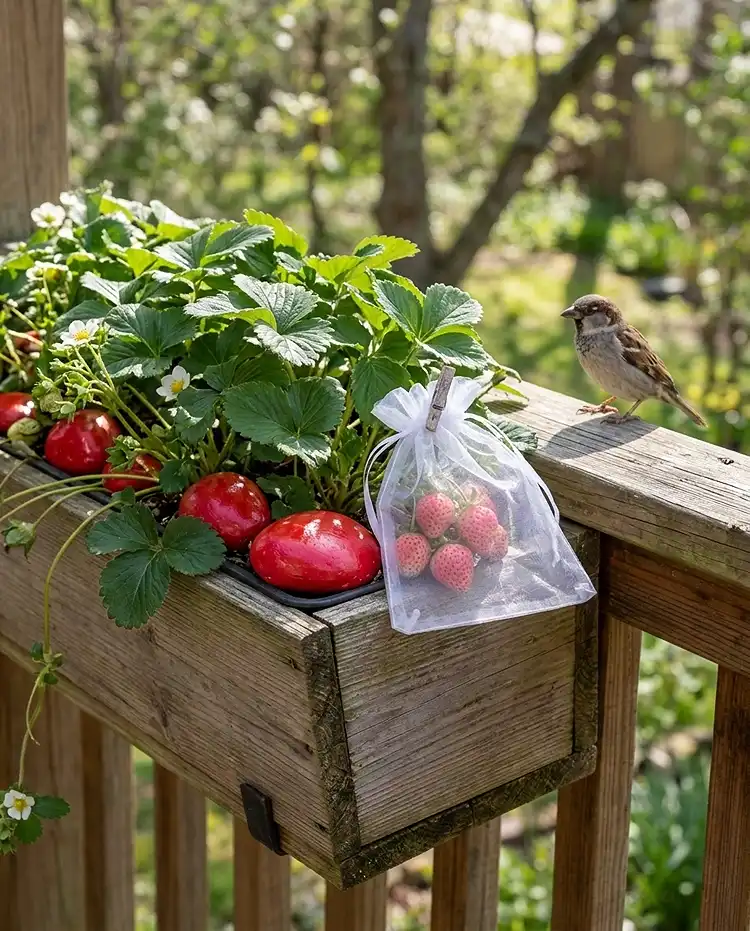
Short Answer: Paint river stones red like strawberries and tuck them into your pots in April. Birds peck the hard rocks, get frustrated, and often leave before real fruit ripens. For extra protection, clip breathable organza mesh bags over hanging berry clusters once the fruit turns pink.
Squirrels are smarter, so I rely on the mesh bags for them. Pick berries when they’re fully red, and don’t leave ripe fruit overnight. Both pests love the sweet smell.
Crown Rot, Gray Mold (Botrytis), and Crispy Brown Leaf Margins in Pots
Short Answer: Burying crowns too deep or watering overhead in the evening rots the plant’s heart and grows gray, fuzzy mold [botrytis]. Raise any sunken crowns and water only at the soil line in the morning. Flush out tap-water salt buildup monthly by letting water run freely through the pot.
Brown, crispy leaf edges usually point to salt buildup rather than disease. Flush the pot slowly with plain water until it runs clear from the bottom. Then clip off any moldy fruit right away, so it can’t spread.
Frequently Asked Questions
How many strawberry plants do I need on my balcony to get a good harvest?
Plan on 6 to 10 day-neutral strawberry plants per person. That fits easily in one 5-tier tower or two 30-inch railing boxes. Each healthy plant gives roughly 1 pound, or about a quart, of berries across the season.
Should I buy bare-root strawberry crowns or potted starter plants for a balcony?
Bare-root crowns come in bundles of 10 to 25 in early spring, and they’re the cheapest way to fill a tall tower. Potted 4-inch starters bought in April or May give beginners a head start, with berries in about three weeks.
Do strawberry plants in balcony pots come back every year?
Yes. Strawberries are cold-hardy perennials in zones 4 to 9. They usually return for three to four years if their pots are sheltered from wet freeze-thaw cycles. When plants tire, root their summer runners for free replacements.
Why are my balcony strawberries small, sour, or woody?
Usual causes: fewer than six hours of sun, a pot drying out while berries swell, or too many runners. Water in the morning, snip extra runners, and feed with a potassium-rich organic liquid fertilizer.
Can I grow strawberries on a shady balcony?
Yes, choose alpine strawberries like ‘Alexandria’ or ‘Yellow Wonder’. They fruit on just 3 to 4 hours of gentle sun. Expect small, fragrant berries rather than big ones.
Quick Recap
- Growing strawberries on balcony space works best with day-neutral plants like ‘Albion’ and ‘Seascape’.
- Give plants six hours of sun, or four hours for alpines, and check railing weight limits.
- Plant each crown flush with the soil line in a pH 5.5 to 6.5 mix.
- Pinch early flowers, snip extra runners, and feed every 14 days.
- Mulch under fruit, then shelter pots against a wall before nights hit 20°F.