
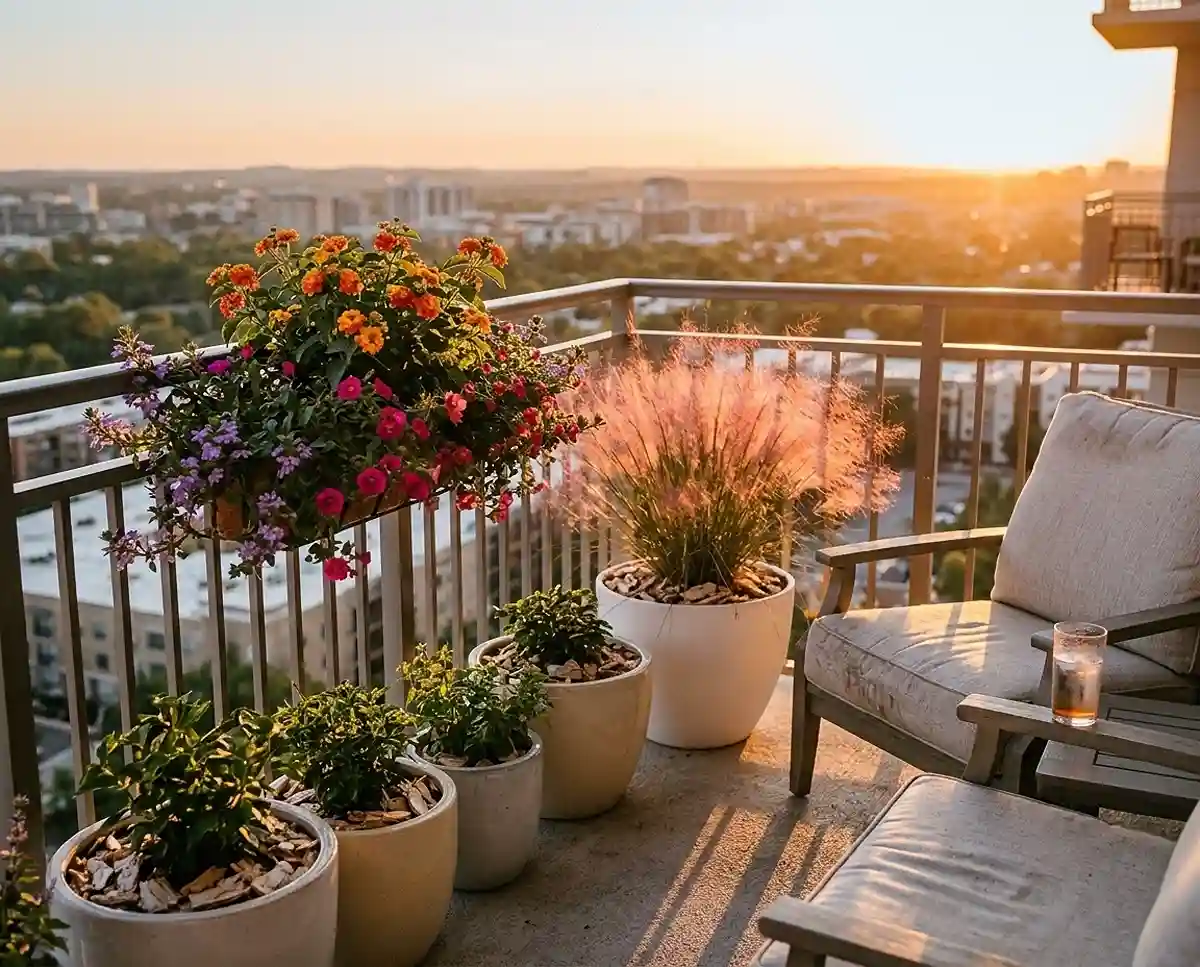
West Facing Balcony Plants for Hot Afternoon Sun
Your west facing balcony plants nap in cool shade until 1 PM, then get blasted. Here’s how to handle that afternoon sun balcony whiplash without losing a pot.
I’m a former community-garden coordinator. My zone 7a rooftop terrace faces west, and I grow in fabric bags, glazed ceramic, and terracotta pots. After 12 years of coaching renters, I’ve watched this cool-morning, scorching-afternoon swing fry plenty of good intentions.
Table of Contents
Understanding the West Facing Balcony “Thermal Shock” Microclimate
Short Answer: A west-facing balcony sits in cool shade until about 1:00 PM, then takes full UV and radiant heat until sunset. Plants face a sudden temperature jump, not just long sun. Choose heat-tolerant plants, shade their roots, and water in the morning before the swing begins.
Morning shade keeps leaves soft and thin. Then the sun swings around, and brick and glass bounce heat back at your pots. Those spots can run 15°F to 20°F (8°C to 11°C) hotter than the open air.
Soft leaves and cool roots get no warning. That’s the whole problem. It’s less about total hours of sun and more about how fast the temperature climbs.
Mapping Afternoon Sun Angles, Wall Heat Bounce, and Wind Desiccation
Spend one sunny day mapping your balcony. At 10 AM, 1 PM, 3 PM, and 6 PM, note where the shade falls. Solid half-walls make micro-shade pockets on the floor behind them. Open railings give no cover at all.
Brick walls and glass doors amplify the heat. On higher floors, wind adds desiccation [moisture stripped from leaves by dry, moving air]. Mark the hottest zones, because those get your toughest plants.
Essential Prep: Root-Insulating Planters and Moisture-Buffering Soil Mix
Short Answer: Pick light-colored, thick-walled containers, add a water reservoir or sub-irrigation, and fill them with a coir, vermiculite, and pine bark mix. This keeps roots below cooking temperatures and holds moisture through the afternoon spike. Roots, not leaves, usually fail first on a west-facing balcony.
Here’s the prep checklist I use before planting anything:
- Light-colored glazed ceramic, thick resin, or white fabric pots that reflect heat
- Self-watering inserts or a reservoir tray to buffer hydration
- Bubble wrap or reed screening for an insulating air gap
- Coco coir, vermiculite, and pine bark fines for the soil
- Light-colored bark or gravel for a mulch top layer
Double-Potting, Light-Colored Planters, and the Afternoon-Sun Soil Recipe
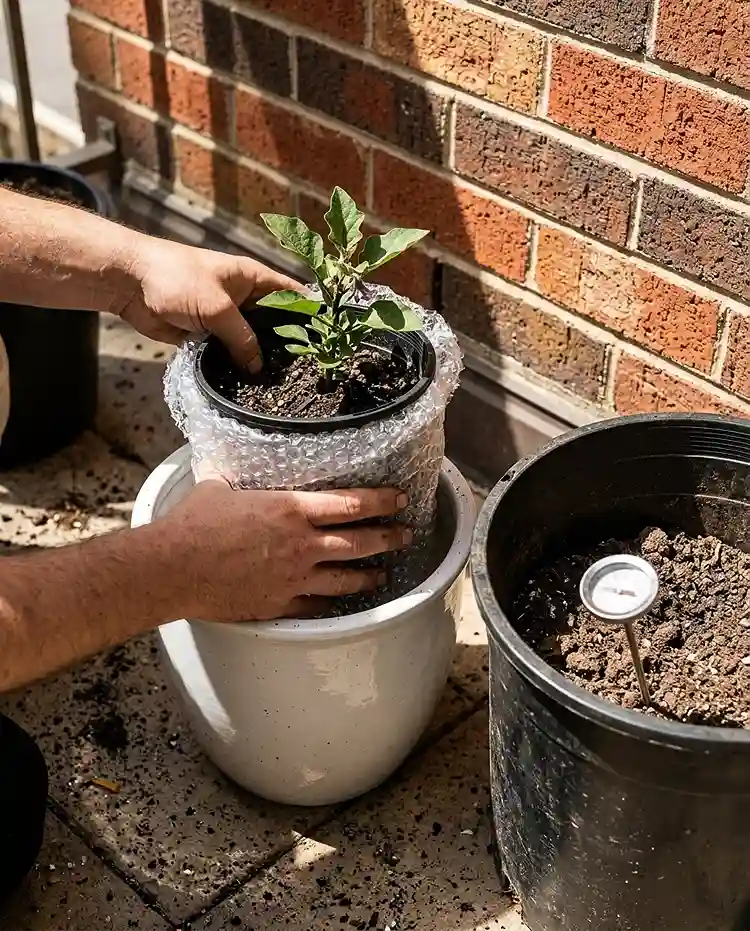
Double-potting [nesting a plastic nursery pot inside a larger decorative pot] gives roots an air buffer. Wrap the inner pot in one layer of bubble wrap. Slide it into a light glazed ceramic or thick resin cachepot [an outer pot without drainage holes].
What Happened to Me: Two Julys ago, I grew ‘Hansel’ eggplant in black 5-gallon plastic buckets. My probe thermometer read 118°F in the soil at 4 PM. Eleven of 14 blossoms dropped in one week.
I re-potted into nested white pots with a bubble-wrap gap. Within three weeks, I picked nine fruit. The only thing that changed was root temperature.
| Ingredient | Share (by volume) | Job |
|---|---|---|
| Coco coir | 40% | Holds water without packing down |
| Pine bark fines | 30% | Keeps air in the mix and drains fast |
| Vermiculite | 30% | Stores water and nutrients for the afternoon |
For Mediterranean herbs and succulents, swap the vermiculite for coarse grit. They prefer drier feet.
19 West Facing Balcony Plants and Garden Ideas Built for Hot Afternoon Sun
Short Answer: These nineteen ideas pair tough plants with smart placement for a west-facing balcony. Silvery, waxy, and succulent leaves handle the glare, while tall plants and trellises shade your doors and pots. Pick two or three that match your space and sun, and build from there.
Think of this list as a menu for hot balcony planting. For more picks, browse our balcony plants roundup or our full sun balcony plants list.
Idea 1: The Golden-Hour Mediterranean Lounge with Potted Olive Trees and Lavender
Silvery dwarf olive (Olea europaea) and English lavender (Lavandula angustifolia) reflect harsh light and glow at sunset. Use a 15-gallon pot for the olive and 5-gallon pots for lavender. In zone 7a, shelter the olive against a wall in winter.
Idea 2: Heat-Shielding Living Curtain of Passionflower and Mandevilla on a Trellis
Train passionflower (Passiflora) and crimson Mandevilla up a western trellis. They can cut glare on your sliding glass door by half or more. Use 10-gallon pots. Both are tender in zone 7a, so bring them inside before frost.
Idea 3: Scorch-Proof Railing Boxes of Trailing Lantana, Portulaca, and Scaevola
Combine trailing lantana (Lantana camara), moss rose (Portulaca grandiflora), and purple fan flower (Scaevola aemula). Moss rose stores water in fleshy leaves, so it never wilts at 4:00 PM. Use boxes at least 8 inches deep.

Idea 4: High-Heat Chili Pepper, Bush Roma Tomato, and Thai Basil Kitchen Trio
Habaneros, jalapeños, and determinate [bush-type, ripens in one flush] Roma tomatoes love a warm masonry wall. Grow them in 10-gallon breathable fabric bags. As of spring 2026, my last frost landed around April 15, so I set peppers out in early May.

Idea 5: Desert Rock Garden of Agave, Echeveria, and Trailing Burro’s Tail
Style shallow terracotta bowls with blue-gray Agave parryi, rosette echeverias, and cascading burro’s tail (Sedum morganianum). Fleshy leaves store water, so skip daily watering. Echeveria and burro’s tail are tender, so bring them indoors before frost.

Idea 6: Backlit Feather Reed Grass and Pink Muhly Grass Sunset Screen
Calamagrostis ‘Karl Foerster’ and airy pink muhly grass (Muhlenbergia capillaris) catch low western sun like tiny lamps. They also buffer hot wind. My ‘Karl Foerster’ in a 7-gallon pot grew from 2 feet in May to 5 feet by mid-August.

Idea 7: The “Dusk Perfume” Corner with Star Jasmine, Heliotrope, and Night-Scented Stock
Afternoon heat warms the oils in star jasmine (Trachelospermum jasminoides) and heliotrope, so they smell best at cocktail hour. Sow night-scented stock (Matthiola longipetala) in spring, since it fades in peak heat. Shelter star jasmine in winter.
Idea 8: Sub-Irrigated Self-Watering Trough of Patio Eggplant and Sweet Bell Peppers
Pair glossy purple ‘Hansel’ eggplant with mini bell peppers in a wicking [water pulled upward from a reservoir] trough. Steady moisture helps prevent blossom drop on hot afternoons. Fill the reservoir each morning.
Idea 9: Drought-Hardy Pelargonium (Zonal Geranium) and Silver Dusty Miller Window Box
Zonal geraniums have waxy stems and felted leaves that shrug off baking western exposure. Pair them with silver dusty miller, which reflects light. Use a 24-inch window box. Let the top inch of soil dry between waterings.
Idea 10: Tiered “Canopy and Understory” Grouping Using Dwarf Citrus to Shade Tender Herbs
Place a bushy ‘Improved Meyer’ lemon on the western edge. Its canopy throws dappled shade over parsley and mint behind it. Put the 15-gallon pot on wheels. Roll it indoors before frost, since it’s only hardy in zones 9 to 10.

Idea 11: Hummingbird Magnet Pot of Salvia ‘Amistad’, Cuphea, and Dwarf Butterfly Bush
Group Salvia ‘Amistad’, cigar plant (Cuphea ignea), and compact ‘Pugster’ butterfly bush (Buddleia) for a nectar-packed corner. All three handle heat. Use 10-gallon pots, and set them within a few feet of your seat.
Idea 12: Sun-Tolerant Coleus (‘FlameThrower’) and Black Sweet Potato Vine Foliage Drama
Sun-bred coleus like ‘FlameThrower’ and trailing sweet potato vine (Ipomoea batatas ‘Blackie’) handle morning shade and afternoon blaze. Pinch coleus tips every two weeks. Water daily in July, because their big leaves lose moisture fast.

Idea 13: Upcycled Olive-Oil Tin Wall of Rosemary, Oregano, and Creeping Thyme
Woody Mediterranean herbs tend to concentrate their essential oils when hot sun and gritty soil stress them a little. Punch drainage holes in the tins first. Choose shiny or white tins so they don’t cook the roots.
Idea 14: Tropical Resort Corner with Bronze-Leafed Dwarf Canna Lilies and Hibiscus
Dark bronze foliage on dwarf canna lilies and tropical hibiscus (Hibiscus rosa-sinensis) soaks up strong light and fuels dinner-plate-sized blooms. Feed weekly. Both are tender in zone 7a, so overwinter the cannas dry and the hibiscus indoors.

Idea 15: Cascading Supertunia Vista and Calibrachoa Hanging Baskets on Swivel Hooks
Mount heavy-duty swivel hooks so you can rotate baskets 180 degrees every few days. Every side of your Supertunias and Calibrachoa gets even western light. Use 14-inch baskets with moisture-holding liners, and feed weekly.

Idea 16: Heat-Loving Cut-Flower Grow Bags of Zinnias, Celosia, and Globe Amaranth
Direct-sow globe amaranth (Gomphrena globosa), crested celosia, and ‘Profusion’ zinnias into 7-gallon grow bags after the last frost. They shrug off heat and make fade-proof bouquets. Zinnias often bloom about 60 days after sowing.
Idea 17: Four-Season Hardy Succulent and Sedum ‘Autumn Joy’ Stone Trough (Zones 4-9)
Combine hens and chicks (Sempervivum), Sedum spurium ‘Dragon’s Blood’, and upright stonecrop in a stone trough. This mix survives 100°F (37.8°C) summers and sub-zero winters. Check your zone on the USDA Plant Hardiness Zone Map.
Idea 18: Dwarf Fig (‘Little Miss Figgy’) and Alpine Strawberry Companion Tub
Plant a compact ‘Little Miss Figgy’ fig in a 15-gallon tub. Ring the rim with alpine strawberries as living mulch to keep the soil cooler. The fig’s leaves shade the berries. Wrap the tub in burlap for winter in zone 7a.
Idea 19: Retractable Bamboo Shade Roll and Ferns for the Protected Morning-Bright Inside Wall
The shaded corner against the building, where afternoon rays never land, suits Boston ferns and caladiums. Add a retractable bamboo shade roll to deepen the cover. For more low-light picks, see these north-facing balcony plants.

Mastering West-Facing Balcony Maintenance and Seasonal Care
Short Answer: Water between 7:00 AM and 9:00 AM, mulch bare soil, and feed lightly every week. This routine lets plants fill with water before the 1:00 PM spike and keeps roots cooler. Skip afternoon watering, which can steam roots in hot soil.
Care on an afternoon sun balcony is mostly about timing. Get roots ready before the heat arrives, and the rest gets easier.
Why Morning Watering Is Mandatory on West Balconies, Plus a Seasonal Hydration Chart
Water at 7:00 AM to 9:00 AM, while the balcony is still cool and shaded. Plants build full turgor [cell firmness from stored water] before the sun arrives. Water at 3:00 PM, and you steam roots in hot soil.
| Season | Morning Watering | Evening Check | Notes |
|---|---|---|---|
| Spring | Every 2-3 days | Not needed | Seedlings dry out faster than you’d expect |
| Summer | Daily, deep soak | After 7 PM for small pots | Fabric bags dry out fastest |
| Fall | Every 2-3 days | Not needed | Good season for lettuce and cilantro |
| Winter | When the top 2 inches are dry | Not needed | Usually every 7-10 days |
Mulching Bare Soil, Liquid Seaweed Feeding, and Winter Freeze-Thaw Protection
Add a 2-inch layer of light-colored pine bark or gravel to keep root zones about 10°F (5.5°C) cooler. Feed weekly with liquid seaweed to boost heat resilience.
In winter, sunny afternoons thaw pots, and then they refreeze overnight. Wrap pots in burlap and group them against the wall to slow those swings.
Common Problems and Solutions
Short Answer: Three problems hit west-facing balconies hardest: leaf bleach on new plants, boiled roots in dark pots, and spider mites in dusty corners. Each has a simple fix. Harden plants off [gradually expose them to sun], use light-colored containers, and rinse foliage in the cool morning.
Sudden 2:00 PM Leaf Bleach and Sunburn on Newly Purchased Nursery Plants
Greenhouse plants have thin, soft leaves, and afternoon UV scorches them within hours. The fix is a 7-day routine using 30% shade cloth or a sheer white curtain clipped to the railing.
What Happened to Me: One May, I parked a dozen ‘FlameThrower’ coleus at the railing. By 2 PM the leaves had bleached, and I lost four plants. The next year, I used this schedule and lost none.
- Days 1-2: Shade cloth over the plants all day
- Days 3-4: Remove the cloth in the morning, replace it by noon
- Days 5-6: Use the cloth only from 1:00 PM to 4:00 PM
- Day 7: Remove the cloth and watch for scorch

Boiled Roots in Black Plastic or Dark Metal Planters Against West Walls
Dark plastic and metal containers can reach 125°F (51.7°C) in late afternoon sun. That kills the feeder roots on the west side of the pot. Wrap pots in reed screening, paint them white or terracotta, or shade the bases behind a lower trough.
Two-Spotted Spider Mite Outbreaks in Hot, Stagnant Afternoon Wall Corners
Dusty, bone-dry heat trapped against walls triggers two-spotted spider mite outbreaks. Look for fine webbing and speckled leaves. Rinse foliage with a cool morning shower.
Spray insecticidal soap at dusk, never in strong sun, or you’ll burn the leaves. Repeat every 5 to 7 days for three rounds.
Frequently Asked Questions
Does a west facing balcony count as full sun or partial sun?
Technically, 4 to 6 hours of direct light borders on partial sun. But afternoon rays from 1:00 PM to sunset are far more intense than morning light. Choose plants labeled for full sun and heat tolerance, and save partial-sun plants for shaded floor corners.
Why do my west-facing balcony plants droop every afternoon even when the soil is wet?
That’s usually transpirational wilt [hot wind pulls moisture from broad leaves faster than roots can replace it]. Don’t panic-water wet soil, because that invites root rot. Leaves typically perk back up by sunset, or you can add temporary afternoon shade.
Can I grow lettuce and cilantro on a hot west-facing balcony?
Only in spring and fall. Both bolt [flower and turn bitter] fast on an exposed western railing in summer. For summer harvests, tuck their pots on the floor behind a solid railing or a larger planter that blocks afternoon sun.
What are the toughest, most indestructible plants for a scorching west balcony?
Rosemary, lantana, moss rose (Portulaca), agave, sedum, zonal geraniums, and dwarf olive trees. Silvery, waxy, or succulent foliage is your clue. These plants thrive on a little neglect, so let the soil dry between deep waterings.
What time should I water plants on a west facing balcony?
Water between 7:00 AM and 9:00 AM. The balcony is still cool and shaded, so plants fill with water before the afternoon blast. Avoid 3:00 PM watering, since hot soil can steam roots. In July, small pots may need a second drink after 7:00 PM.
Do I need shade cloth on a west-facing balcony?
Only for new or tender plants. A 30% shade cloth or sheer white curtain on the railing helps nursery plants adjust during a 7-day hardening-off period. Established heat-tolerant plants usually don’t need it.
Quick Recap
- Pick west facing balcony plants with silvery, waxy, or succulent leaves, and check tags for full sun and heat tolerance.
- Use light-colored, double-potted containers so afternoon sun can’t cook the roots.
- Fill pots with a coco coir, pine bark, and vermiculite mix, then add 2 inches of light mulch.
- Water between 7:00 AM and 9:00 AM, and skip mid-afternoon watering.
- Harden off new plants for 7 days, and rinse leaves each morning to keep spider mites away.