

Balcony Reading Nook Ideas With Cozy Container Plants
The best balcony reading nook ideas don’t require square footage — they require strategy. With the right chair placement and a few well-chosen container plants, even a cramped apartment balcony becomes a private botanical retreat.
Table of Contents
Crafting the Ultimate Urban Escape: The Balcony Reading Nook
You slide open the glass door, and the city noise hits you. But then you step into your corner. Tall grasses rustle. Jasmine drifts past. The chair practically pulls you in.
That’s not luck — that’s intentional design. A well-built small balcony garden reading nook creates genuine psychological distance from everything on the other side of that door.
I grow plants on a north-facing balcony in zone 6b, and I’ve spent three seasons figuring out exactly which combinations make a space feel like an escape rather than a cluttered ledge.
The secret is treating your balcony as a room. Define its walls with plants, soften its floor with a rug, and frame its ceiling with hanging vines. Once you do that, the urban backdrop disappears.
Assessing Your Balcony Layout for a Cozy Nook
Before you buy a single pot, audit your space. A relaxing reading environment needs protection from three things: glaring sun on your pages, wind that rattles your book, and sightlines from neighboring units.
Walk your balcony at different times of day. Note where the sun hammers, where the wind tunnels, and where you’d feel exposed sitting down. Your nook goes in the spot that fails all three tests the least.
Selecting the Anchor Corner
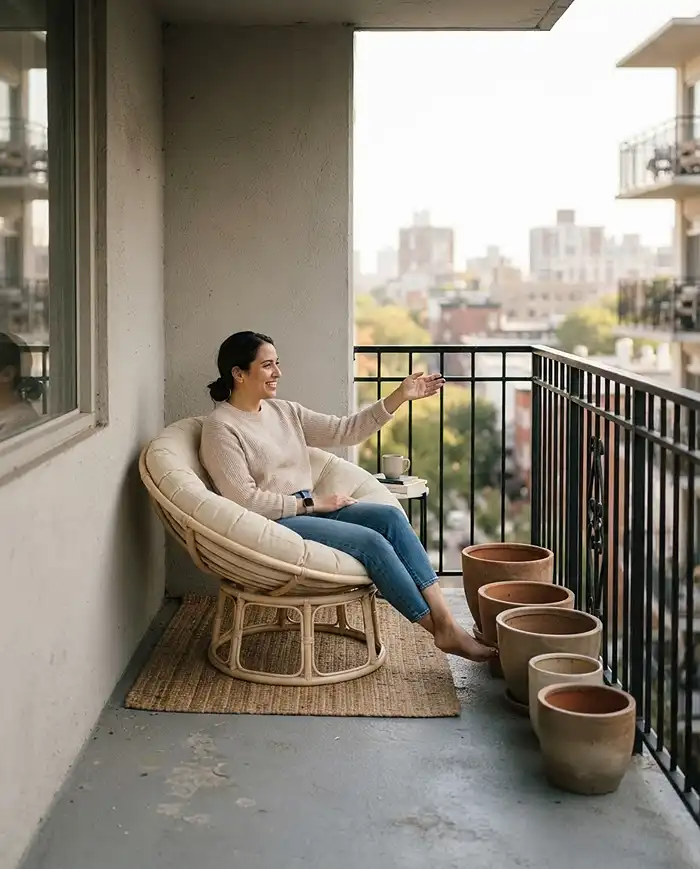
Quick Answer: Place your chair in the deepest corner of your balcony, with your back to the exterior apartment wall. Two solid walls behind you immediately create enclosure and cut wind by roughly 60%.
The apartment’s exterior walls are your best free resource. They block wind, create acoustic dampening, and give you two sides of a “room” without any plants required.
From that anchor corner, your container plants only need to screen the remaining open sides — the railing edge and the gap toward the door. That’s a much more manageable task than trying to create privacy from scratch in an exposed center position.
In 2023, I tried placing my chair mid-balcony surrounded by pots. It felt like sitting in a parking lot with plants around me. Moving it into the far corner changed everything — same plants, completely different feeling.
Mapping Reading Light and Shadow
Quick Answer: Position your chair so your back faces the sun. This prevents page glare while keeping the plant zone in front of you sun-exposed — most screening plants need at least 4 hours of direct light to thrive.
Track your balcony’s sun pattern for a full day before finalizing the chair position. East-facing balconies get soft morning light — ideal for readers. South and west exposures get afternoon glare that makes reading miserable without shade management.
Your tall screening plants — grasses, bamboo — will go in the sun-facing positions anyway. They’ll naturally cast dappled shade back toward your chair by mid-afternoon, which is exactly when you want it most.
Choosing the Perfect Seating and Decor
Furniture selection for a small balcony garden reading nook is about visual weight as much as physical size. The wrong chair will make the space feel like furniture storage. The right one disappears into the planting.
The rule: one great seat, not two okay ones. A single deeply comfortable chair surrounded by lush plants beats a loveseat with nothing around it every time.
Space-Saving, Comfortable Seating
Quick Answer: The three best options for a balcony reading nook are a papasan chair (deep comfort, round profile that works with curved plant arrangements), a hanging macrame egg chair (zero floor footprint), or a narrow outdoor chaise lounge (suits east-facing balconies with morning sun).
Here’s how they compare:
| Chair Type | Best For | Floor Footprint | Watch Out For |
|---|---|---|---|
| Papasan Chair | Enclosed corners, long reads | 36-40 inches diameter | Cushion fading in direct sun |
| Hanging Egg Chair | Small balconies, renters | Near zero (hangs from beam) | Ceiling load capacity — check first |
| Narrow Chaise Lounge | Longer balconies, sun lovers | 24 x 60 inches typical | Pushes plants to sides, less enclosure |
Whatever you choose, the seat back should stay lower than your tallest screening plants. If the chair top sticks up above the grass line, the enclosure illusion breaks.
Layering Outdoor Textiles and Ambient Lighting
Quick Answer: Layer a polypropylene outdoor rug first, then weather-resistant throw pillows, then solar fairy lights woven through the railing. This three-layer approach transforms bare concrete into a room that feels designed rather than assembled.
Start with the rug — it’s the single highest-impact change you can make. A 4×6 foot polypropylene rug in a neutral tone (warm grey, natural jute-look) grounds the seating area and visually separates the “nook” from the rest of the balcony.
For pillows, look for solution-dyed acrylic fabrics. They resist mildew and UV fade far better than standard outdoor fabric. One or two solid-colored pillows plus one with subtle texture is enough — more starts to look chaotic in a small space.
Solar fairy lights strung along the railing or woven through a trellis create warm, low-voltage evening reading light. Warm white (2700K-3000K) reads as cozy. Cool white reads as clinical — avoid it.
Pro Tip: Clip a small book light to your chair back for actual reading after dark — fairy lights are ambiance, not task lighting.
Framing the Nook: Best Plants for Privacy and Ambiance
Every plant in a reading nook earns one of three jobs: screen, scent, or ceiling. Pick species that do their job well in your specific light conditions, and your apartment balcony garden ideas will feel cohesive rather than collected.
Check out these apartment balcony garden ideas for more plant inspiration before you start shopping.
Tall Structural Screens (Bamboo and Ornamental Grasses)
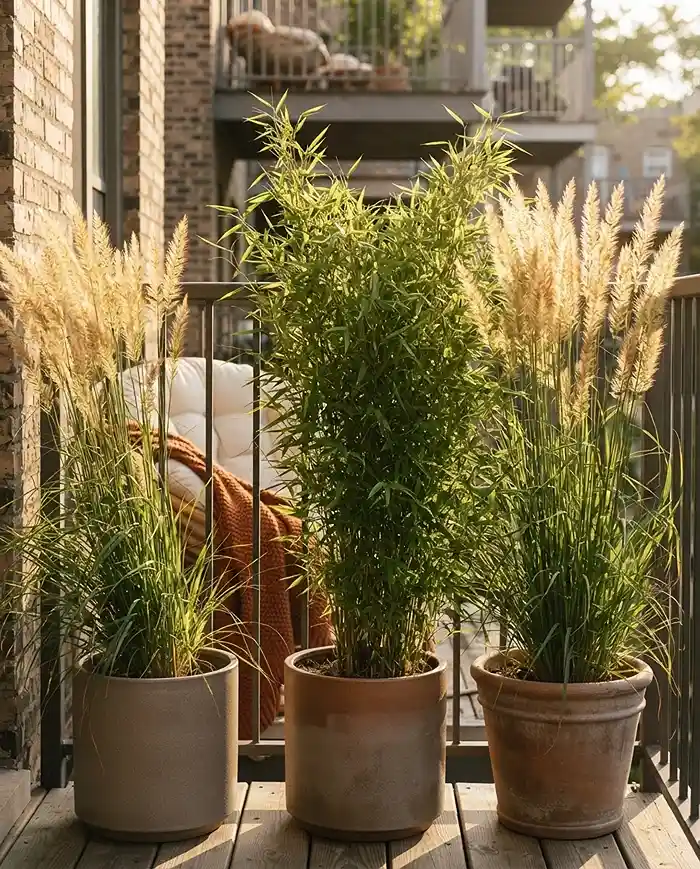
Quick Answer: Clumping bamboo (Fargesia species) and ‘Karl Foerster’ feather reed grass are the two best structural screens for balcony nooks. Both grow 5-6 feet tall in containers, block sightlines, and produce constant rustling that masks street noise naturally.
Fargesia is the critical bamboo choice here — it’s clumping, not running, so it won’t escape its pot and take over. It tolerates partial shade, making it viable on north and east exposures where most screening plants struggle.
‘Karl Foerster’ feather reed grass is my go-to for sunny balconies. I planted three 5-gallon containers of it in spring 2022, and by July they were 5.5 feet tall — a complete visual wall from the street-facing side of my balcony.
The bonus: both species produce constant gentle movement in any breeze. That rustling acts as white noise, doing as much for reading focus as any noise-canceling headphones.
Fragrant Herbs and Flowers (Lavender, Jasmine, Mint)
Quick Answer: Place aromatic plants within arm’s reach of your chair. Brushing lavender, creeping thyme, or Star Jasmine (Trachelospermum jasminoides) while settling in releases calming essential oils that meaningfully enhance a reading session.
Lavender ‘Hidcote’ in a terracotta pot placed just beside the chair arm is my non-negotiable. It’s compact (12-14 inches), blooms June through August in zone 6b, and the scent is strongest when you brush against it — which happens naturally as you sit down.
Star Jasmine is the choice if you want fragrance that carries without contact. Trained up a small obelisk trellis, it flowers May-June with an scent that fills the entire nook. One established plant can perfume 40-50 square feet.
Mint is worth including for one underrated reason: it repels aphids that would otherwise attack your showier plants. Keep it slightly contained — a pot-within-a-pot — or it’ll try to colonize everything nearby.
Cascading Ceiling Spillers (Pothos and Creeping Jenny)
Quick Answer: Hang trailing plants at 6.5-7 feet height to create a soft overhead canopy that lowers the perceived ceiling of your nook. Golden Pothos works for shade; Creeping Jenny (Lysimachia nummularia ‘Aurea’) works for sun. Both trail 3-4 feet within a single season.
The ceiling layer is the most overlooked element of a reading nook. Without it, you have a chair with plants around it. With it, you have an enclosed space — and enclosed spaces feel safe and private in a way open ones don’t.
Hang three macrame baskets in a loose arc above the seating zone at roughly 6.5 feet. Space them 18-24 inches apart. Within 8-10 weeks of planting, Golden Pothos will trail down 24-36 inches, creating a soft green curtain overhead.
I tried this with Creeping Jenny on my south-facing section in summer 2024. By August, the trailing stems had dropped nearly 3 feet, and the entire corner felt like a grotto. Every guest asked how long I’d been building it — it had been ten weeks.
Pro Tip: Use lightweight plastic nursery pots inside your macrame hangers, not heavy terracotta — ceiling anchors have weight limits, and ceramic adds up fast.
Step-by-Step Guide to Styling the Nook
Order matters. Style the nook in this sequence and you’ll avoid repositioning everything three times:
- Roll out the rug first. Everything else is positioned relative to it. Center your chair on the rug, pushed toward your anchor corner.
- Set the chair and test sightlines. Sit down. Note exactly where you can see neighbors or street. Those are your screen targets.
- Place tall grass/bamboo screens at the railing edge and any open sightline gaps. Push containers flush against the railing to maximize floor space.
- Hang the overhead spillers before placing anything below them — you don’t want to disturb plants after hanging. Let them settle for a week before adjusting positions.
- Add the fragrant herbs on a small side table or plant stand at elbow height, within easy reach of the chair. This is your final step so they don’t get knocked during setup.
- String the fairy lights last. Weave them through the railing and into the grass stems, then test at dusk before committing to the final arrangement.
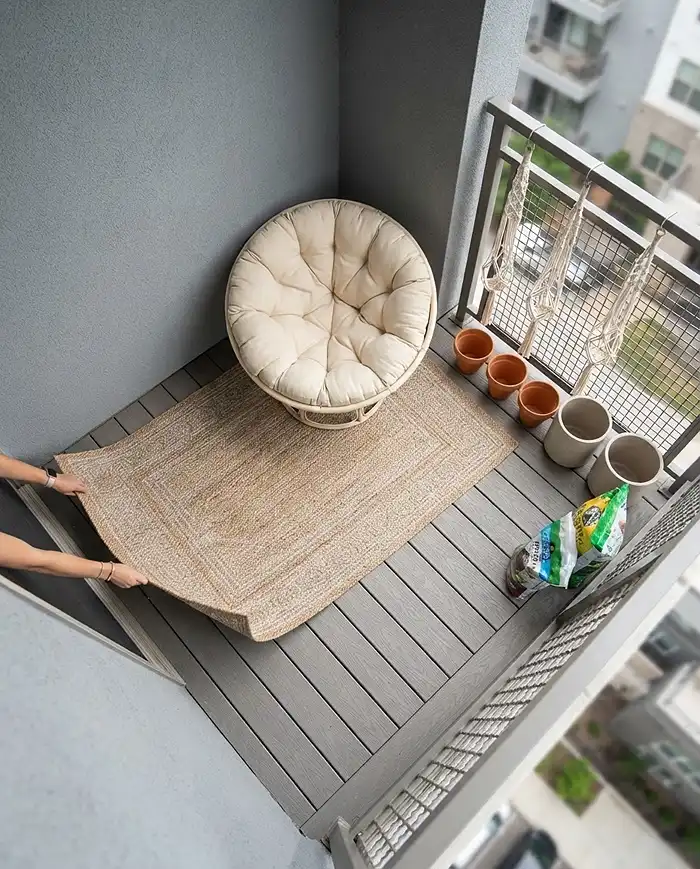
For more inspiration on pulling the whole look together, browse these cozy balcony ideas with plants before you finalize your plant selection.
Maintenance Routine for a Pristine Reading Area
A densely planted balcony nook creates one real maintenance risk: wet soil and drip runoff reaching your cushions and rug. Address this system-level, not plant-by-plant, and the routine becomes quick.
The goal is a dry, leaf-free seating zone at all times — because a soggy rug or muddy armrest means you won’t actually use the space.
Drip-Free Watering and Targeted Pruning
Quick Answer: Use glazed ceramic drip trays (sized to match each pot exactly) and water via a long-neck watering can aimed at the soil base — never overhead. Bottom-watering large pots by setting them briefly in water-filled saucers eliminates splash entirely.
The worst balcony watering mistake is using a hose or spray wand near the seating area. It mists everything — cushions, rug, book. Switch to a narrow-spout watering can and take your time. It takes 90 extra seconds and saves your cushion fabric.
For trailing vines near the chair, prune weekly. Creeping Jenny and Pothos grow fast in summer — a tendril that was above your shoulder Monday will be at knee height by Friday. Snip any stem that reaches into the seating zone before it contacts the cushion.
Sweep fallen leaves from the rug daily during fall. One minute with a hand brush keeps the space looking cared-for, and decaying leaves on outdoor rugs cause mildew faster than almost anything else.
Common Problems and Solutions
Two problems kill most balcony reading nook projects: pests near the chair and visual overwhelm from too many mismatched pots. Both are fixable within a weekend.
Managing Wasps and Pests Near the Chair
Quick Answer: Place lemon balm and citronella-scented geraniums immediately beside the chair to deter stinging insects. Move sweet, bee-attracting flowers like lavender and jasmine to the outer railing — 4-6 feet from seating — so pollinators never need to enter the nook.
This is a zoning strategy, not a chemical one. Insects follow scent. If the strongest sweet scent is at the railing, that’s where they’ll congregate — not in your reading corner.
Lemon balm releases its mosquito-repelling oils when leaves are brushed or crushed, so a single pot beside your chair arm does double duty as both pest deterrent and calming aromatherapy while you read.
Claustrophobia and Visual Clutter
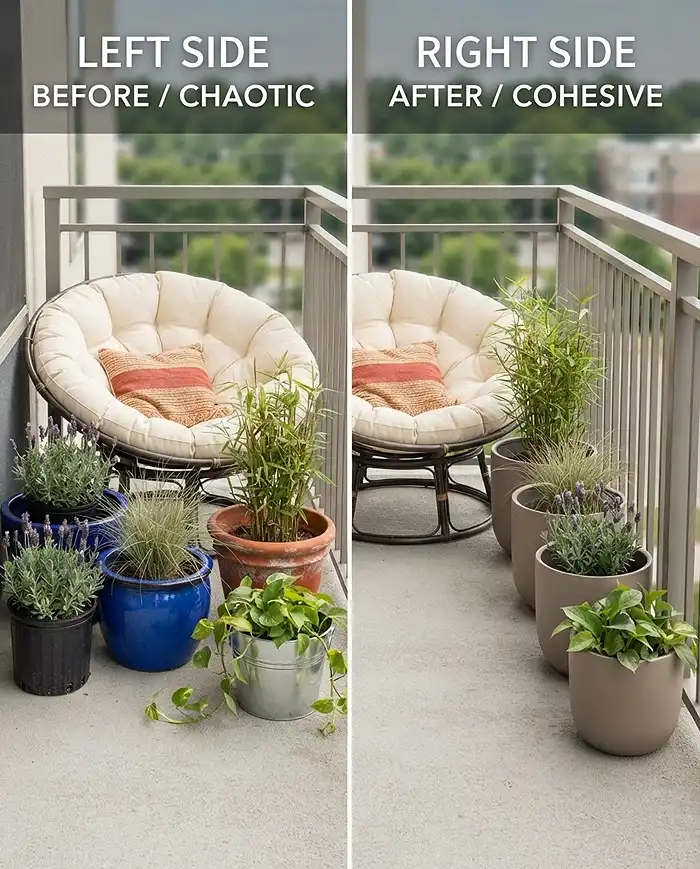
Quick Answer: If your nook feels anxious rather than cozy, the problem is almost always container variety, not plant density. Unify all pots under one material and color — all terracotta, all white ceramic, or all matte black — and visual chaos collapses immediately.
I learned this the hard way in 2021. I had 11 plants around my chair in an amazing combination of plastic nursery pots, glazed blue pots, terracotta, and a galvanized bucket. The plants were great. The space felt like a garden center stockroom.
I repotted everything into matching warm grey ceramic pots over one afternoon. Same plants, same positions, completely transformed. The planting suddenly read as intentional design instead of accumulation.
Also: sweep fallen leaves every single day. A single afternoon of neglect during leaf-drop season creates a floor covering that reads as “abandoned” no matter how healthy the plants are above it.
Frequently Asked Questions
How much space do I need between the chair and the plants?
Maintain a minimum of 12 to 18 inches between the edge of your chair and the nearest foliage. This prevents wet or soil-covered leaves from brushing your clothing during a reading session and gives you room to stand without disturbing the plants.
How can I protect my reading cushions from rain and soil?
Use outdoor-grade acrylic fabric like Sunbrella, which resists mildew and soil stains. Keep a small waterproof deck box tucked under a tall planter to store cushions during watering sessions and storms. Bring cushions inside if rain is forecast overnight.
What are the best plants for a deeply shaded reading nook?
In a zero-direct-sunlight nook, replace sun-loving herbs and grasses with Boston Ferns, Hostas, and Cast Iron Plants (Aspidistra elatior). These thrive in full shade and create a lush, woodland aesthetic that’s genuinely well-suited to a reading atmosphere.
Can I build a balcony reading nook on a rental apartment balcony?
Yes. Use freestanding plant stands instead of wall anchors, a hanging egg chair with a freestanding frame, and containers with wheels for easy repositioning. No permanent modifications needed. Always check ceiling load capacity before hanging any overhead baskets.
What is the best balcony garden idea for creating privacy fast?
Clumping bamboo in large containers (15-20 gallon pots) is the fastest privacy solution. Fargesia species can reach 5 feet within one growing season from a 3-gallon starter plant. Pair with a trellis panel and fast-climbing Star Jasmine for layered screening.
Key Takeaways
- The best balcony reading nook ideas anchor the chair in a corner first, then build outward with plants — not the other way around.
- Use three plant layers: tall structural screens at the railing, fragrant herbs at elbow height, and trailing vines overhead to create a fully enclosed feeling.
- Unify all containers under one material and color palette — this single change does more for the space than any individual plant selection.
- Bottom-water your containers and use exact-fit drip trays to keep the seating zone permanently dry and cushion-safe.
- For more design ideas, explore balcony garden ideas for apartments and the RHS guide to balcony gardens for expert horticultural guidance on container selection and plant pairings.