
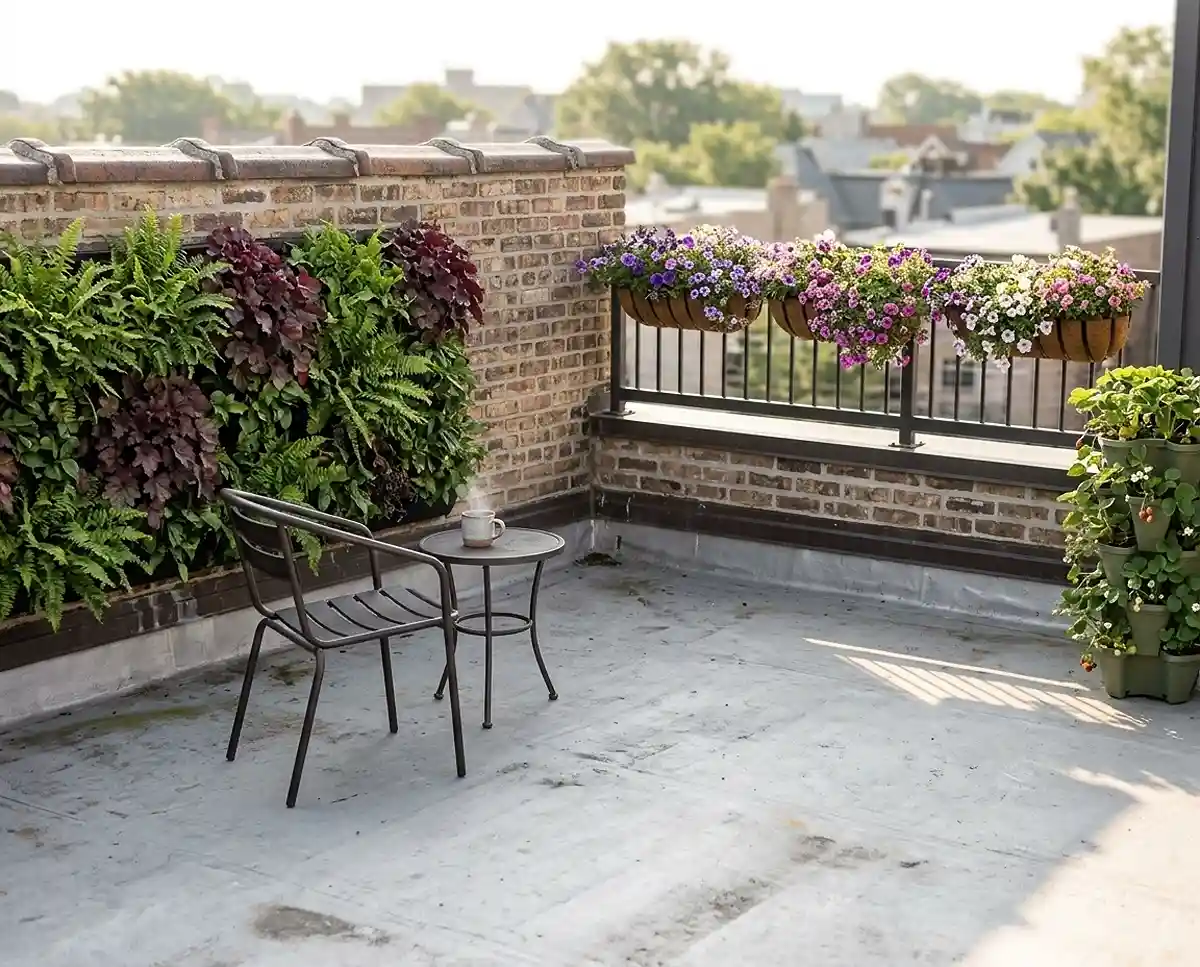
Balcony Vertical Garden Ideas
I once spilled coffee tripping over a tomato pot. A balcony vertical garden fixed that, and a balcony plant wall now grows my herbs while the floor stays clear.
I garden on a sunny rooftop terrace in zone 7a, in about twelve containers, with a brick parapet and steel railing. After 12 years of helping renters grow food in tight spots, I’m convinced of one thing. Walls are free real estate.
Below are 19 ways to build upward instead of outward, plus the soil, watering, and fixes that keep everything alive.
Table of Contents
Planning Your Balcony Vertical Garden: Weight, Microclimates, and Mounting Zones
Short answer: Before you buy anything, audit every vertical surface: walls, railings, corner posts, and the ceiling overhang. Note which ones get sun, which ones can carry weight, and what your lease allows. A ten-minute walk-through with a tape measure prevents most vertical balcony garden mistakes.
Each surface has a job. Railings catch light and wind and carry modest weight. Walls carry the most but often forbid drilling. Ceilings suit the lightest pots, and corners suit freestanding pieces.
Sketch your balcony on paper. Mark where the sun lands at 9 a.m., noon, and 4 p.m. Circle every spot you can mount without drilling, then confirm your railing’s weight rating with your building manager.
Vertical Microclimate Shifts: Sunny, Windy Top Tiers vs. Shaded, Humid Bottom Tiers
Short answer: The top two feet of a vertical wall get more sun and wind, so soil dries much faster than in lower pockets. Put drought-tolerant plants up high, thirsty ones low, and expect different watering needs on every tier of the same wall.
A microclimate [a small pocket where light, wind, and moisture differ from the space around it] forms on every wall. Heat bounces off brick, wind funnels along railings, and water runs downhill.
This container gardening guide from University of Maryland Extension notes that south and west exposures run sunnier and warmer. North and east exposures run shadier and cooler.
Try this on a sunny afternoon. Press a finger into a top pocket, then a bottom one. The difference tells you exactly where each plant belongs.
Essential Prep: Renter-Safe Hardware, Lightweight Containers, and Anti-Gravity Soil
Short answer: Choose zero-drill mounts, lightweight containers, and a featherweight potting mix before you plant anything. Wall loads stay low, drips stay off your neighbor’s balcony, and your landlord stays happy. Gather these basics first so every idea below goes up in an afternoon.
Water-filled soil is heavy. A wet cubic foot of bagged potting mix can top 30 pounds, so light containers and light mix come first.
For more removable mounting ideas, these renter-friendly balcony planter solutions are a good starting point. Then gather this checklist:
- Spring-loaded tension poles rated for outdoor use
- Over-the-rail saddle brackets and stainless steel zip ties
- Lightweight polypropylene or fabric planters with drainage holes
- Clamp-on beam hooks and locking carabiner clips
- Narrow drip trays or saucers for every column
The “Featherweight Sponge” Potting Mix Recipe for Vertical Pockets and Hanging Pots
Short answer: A blend of rehydrated coco coir [shredded coconut husk], perlite, pine bark fines, worm castings, and vermiculite works like a sponge. It holds water yet weighs half as much as compost-heavy soil. Use it in every small vertical pocket and hanging pot.
Measure by volume, and soak the coir until it fluffs up:
- 4 parts rehydrated coco coir
- 2 parts coarse perlite [puffed volcanic glass that keeps soil airy]
- 2 parts pine bark fines
- 1 part worm castings
- 1 part vermiculite [a heat-expanded mineral that stores water] or wool pellets
Last spring I weighed two matching 24-inch rail troughs. The one with bagged compost mix hit 22 pounds wet. The one with this recipe weighed 11 pounds and grew ‘Dark Opal’ basil to harvest size in 38 days.
19 Balcony Vertical Garden Ideas That Free Up Your Floor Space
Short answer: These 19 ideas cover four mounting zones: walls, railings, freestanding corners, and overhead ceilings. Each one frees up floor space and comes with plant pairings that suit its light and moisture. Pick two or three that match your balcony’s sun, not all nineteen.
Idea 1: Modular Interlocking Living Wall Panels of Ferns, Heuchera, and Trailing Pothos
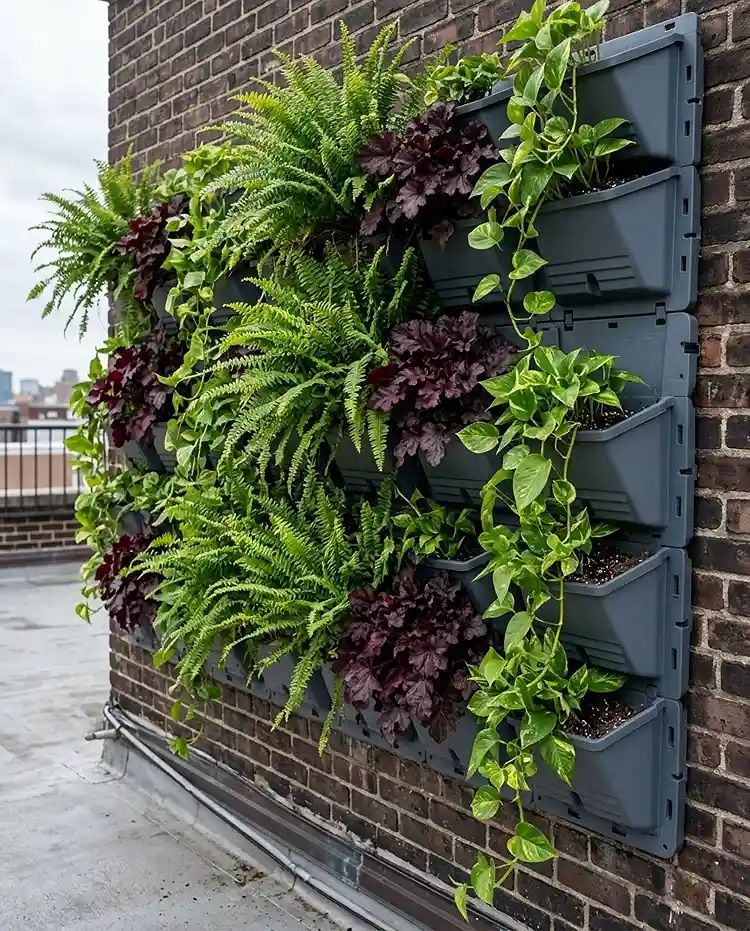
Clip-together polypropylene wall modules with built-in water reservoirs turn a shaded brick wall into a balcony plant wall in one afternoon. Plant Boston ferns, burgundy ‘Palace Purple’ coral bells, and trailing pothos. Top up the reservoir weekly, and check the corners, which dry first.
Idea 2: Floor-to-Ceiling Renter Tension Pole with Swivel Ring Pots in Dead Corners
A spring-loaded outdoor tension pole wedges into a one-square-foot corner without a single drill hole. Hang six staggered 6-inch terracotta pots on swivel rings. Fill them with cascading petunias, English ivy, and herbs like thyme and chives, and rotate the ring to chase sun.
Idea 3: Over-the-Rail Saddle Troughs and Hanging Hayracks for Zero-Footprint Blooms
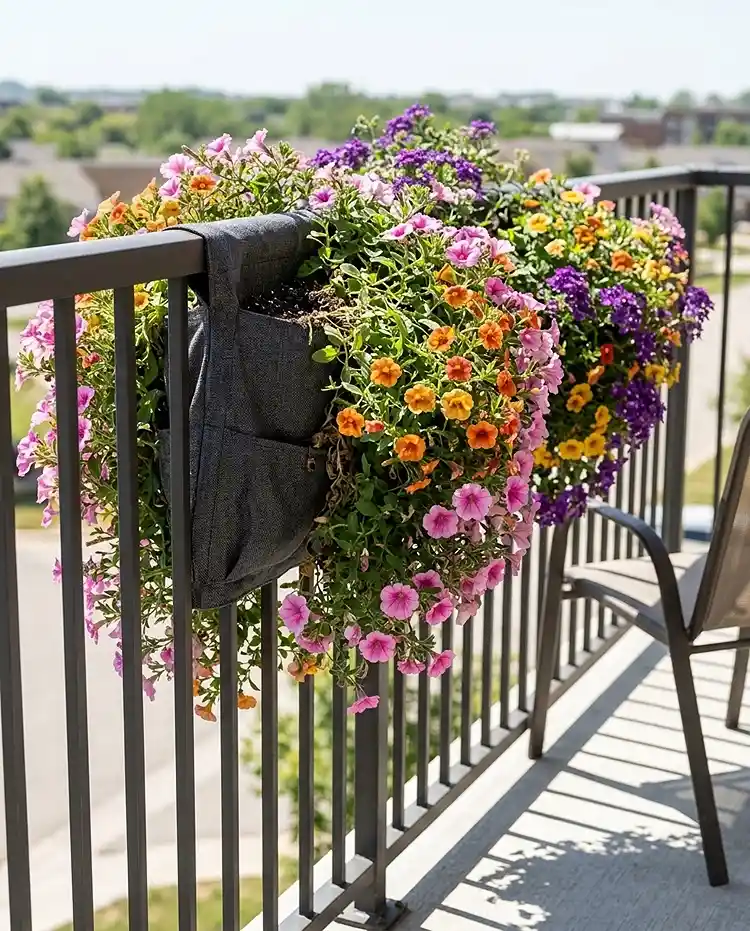
Dual-sided saddle planters straddle the top rail and lift trailing Supertunia petunias, calibrachoa, and verbena to eye level. They add zero floor footprint, so chairs and foot traffic keep their space. Use the lightweight mix above and keep each trough under 15 pounds per linear foot.
Idea 4: Slatted Cedar Wall Trellis with French-Cleat Removable Herb & Salad Boxes
Lean or clamp a slatted cedar trellis against the wall. Hook on angled wooden boxes using French cleats [two-piece angled strips that lock a box in place]. Fill them with ‘Black Seeded Simpson’ lettuce and flat-leaf parsley, and unhook a box to harvest or to chase the sun.
Idea 5: Stackable 5-Tier Rotating Tower Planter for Strawberries and Leafy Greens
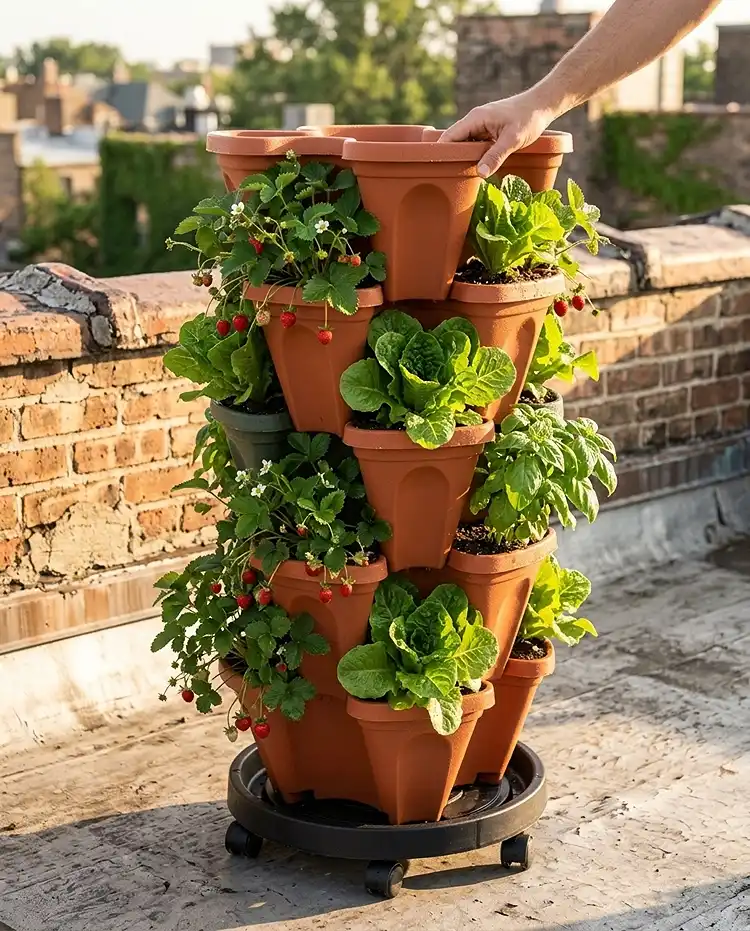
A stackable five-tier tower on a 14-inch wheeled base is a freestanding vertical garden with a pizza-pan footprint. It holds 20-plus alpine strawberries, romaine, and basil. Roll it out for morning sun and tuck it back against the wall by evening.
Idea 6: Cascading Rain-Gutter Cable Wall for Shallow-Rooted Succulents and Greens
Suspend three tiers of vinyl rain gutters on stainless steel aircraft cable from a beam clamp, hung against a sunny wall. Drill drainage holes in the bottom of each run. Shallow roots love it, so plant sedum, portulaca, or arugula you can harvest leaf by leaf.
Idea 7: Breathable Felt Pocket Planter Hung Over an Exterior Storage Closet Door
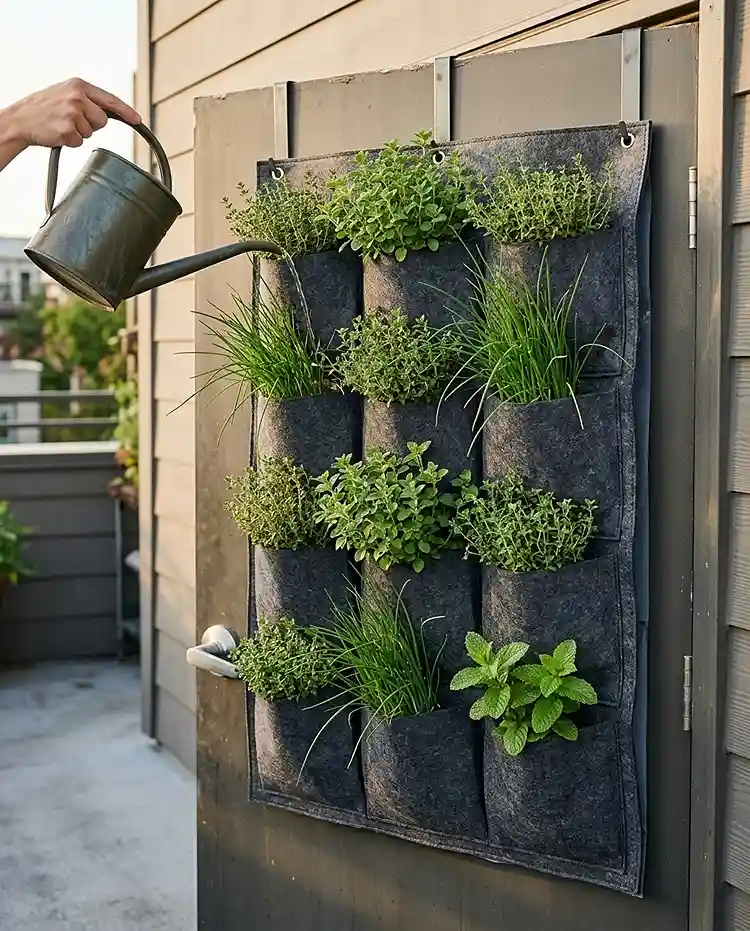
A waterproof-backed 12-pocket felt planter turns a dead utility door into a culinary garden. Hang it over the top edge and fill the pockets with thyme, oregano, chives, and mint. Give mint its own pocket, since it bullies its neighbors. Water slowly so the pockets can absorb it.
Idea 8: Narrow Under-Trellis Trough with Climbing Star Jasmine and Passionflower
A slim 8-inch-wide trough hugged against the wall holds a 7-foot expandable willow trellis. Train star jasmine (Trachelospermum jasminoides) up it for fragrance. It’s hardy only to about zone 8, so in zone 7a, overwinter it indoors or add maypop passionflower.
Idea 9: Staggered Ceiling-Hung Macramé and Coco-Basket “Green Curtain”
Hang fuchsias, spider plants, and trailing begonias at two alternating chain lengths from ceiling joists or clamp-on beam hooks. The staggered heights create a leafy privacy curtain and keep the deck clear. Fuchsias like cool shade, so save brighter spots for begonias.
Idea 10: Upcycled Heat-Treated Wooden Pallet Wall Stuffed with Moss and Annuals
Line the inside slats of a standing pallet with landscape fabric and sphagnum moss. Choose a heat-treated pallet stamped HT, not MB, which means methyl bromide. Then pack the pockets with impatiens, coleus, and sweet alyssum. Lean it against the wall and strap it to the railing.
Idea 11: Balcony Railing Nylon Netting Wall for Vertical Sugar Snap Peas and Mini Cucumbers
Stretch trellis netting from a narrow railing-base box up to the top rail. It costs about $5 to $8 as of fall 2026. ‘Sugar Ann’ snap peas climb about 30 inches, while ‘Sugar Snap’ reaches 6 feet, and compact ‘Spacemaster’ cucumbers follow in summer.
I sowed ‘Sugar Ann’ in a 24-inch box on March 15, when the soil hit 45°F. First pods came 58 days later. I picked about two pounds over five weeks from that one box.
Idea 12: Wall-Mounted Exterior Pegboard with S-Hook Tin Planters and Garden Tools
Clamp or mount a weather-sealed composite pegboard and hang painted olive-oil tins from S-hooks. Plant sage, flat-leaf parsley, and trailing nasturtiums in the tins, and poke drainage holes first. Use the same board for hand tools, so gardening gear never touches the floor.
Idea 13: Narrow A-Frame Stepped Ladder Stand Tucked Against a Short End Wall
A 12-inch-deep A-frame ladder shelf leans against a short end wall and holds four tiers of medium pots. Put sun-loving ‘Profusion’ zinnias on top and shade-tolerant caladiums on the bottom. Water from the top and let it trickle down.
Idea 14: Espaliered Dwarf Citrus or Fig Tree Trained Flat Against Sunny Masonry
Espalier [train a tree flat against a wall] a dwarf ‘Meyer’ lemon or ‘Little Miss Figgy’ fig. Tie branches to horizontal wires on sunny masonry, and the tree sticks out under 10 inches. In zone 7a, the fig handles winter better, while the lemon must come indoors.
Idea 15: Vertical Metal Grid Panel (Cattle Panel) with Clip-On Ring Brackets for Terracotta Pots
Zip-tie a heavy-gauge welded wire panel to your railing, then clip on six-inch terracotta pots with ring brackets. Arrange them in geometric patterns that you can change anytime. Fill the pots with creeping thyme, oregano, and ‘Lemon Gem’ marigolds, and keep the total load light.

Idea 16: Suspended Copper-Pipe Window Bar Holding Trailing String of Pearls and Ivy
Wedge a heavy-duty outdoor tension rod across a recessed window alcove, then hang lightweight pots from S-hooks. String of pearls (Senecio rowleyanus) wants bright light and dry feet, while English ivy (Hedera helix) tolerates shade. Alternate them on staggered hooks for a green curtain. Bring the pearls indoors before frost.

Idea 17: Corner Obelisk Planter with Dwarf Climbing Roses and Boulevard Clematis
Place a 6-foot metal obelisk in a 14-inch tub in an unused balcony corner. Plant a compact ‘Piilu’ clematis and a dwarf climbing rose at its base. Keep clematis roots cool with bark mulch, and the pillar blooms for months.
Idea 18: Magnetic Vertical Planter Tins Stuck to Metal Balcony Siding and Railings
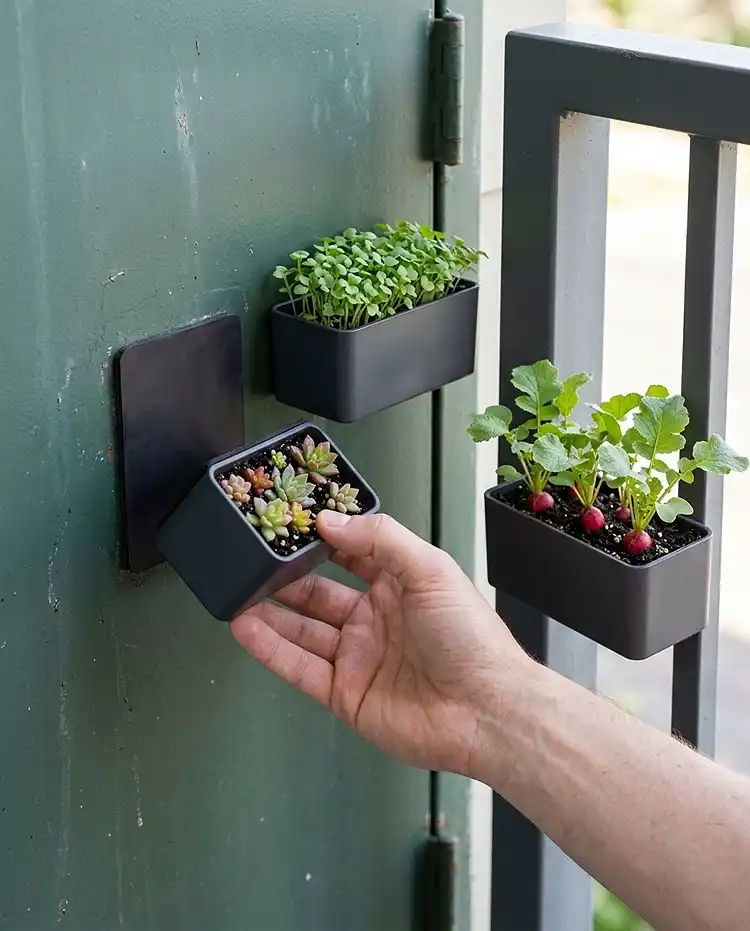
Heavy-duty neodymium magnetic planter boxes snap onto steel balcony siding, metal doors, and railings. Fill them with microgreens, radishes, and baby succulents, which stay light. Pad the magnets with rubber to protect paint, and test the grip before adding wet soil.
Idea 19: Hinged Fold-Down Wall Bistro Table Built Inside a Living Frame Planter Box
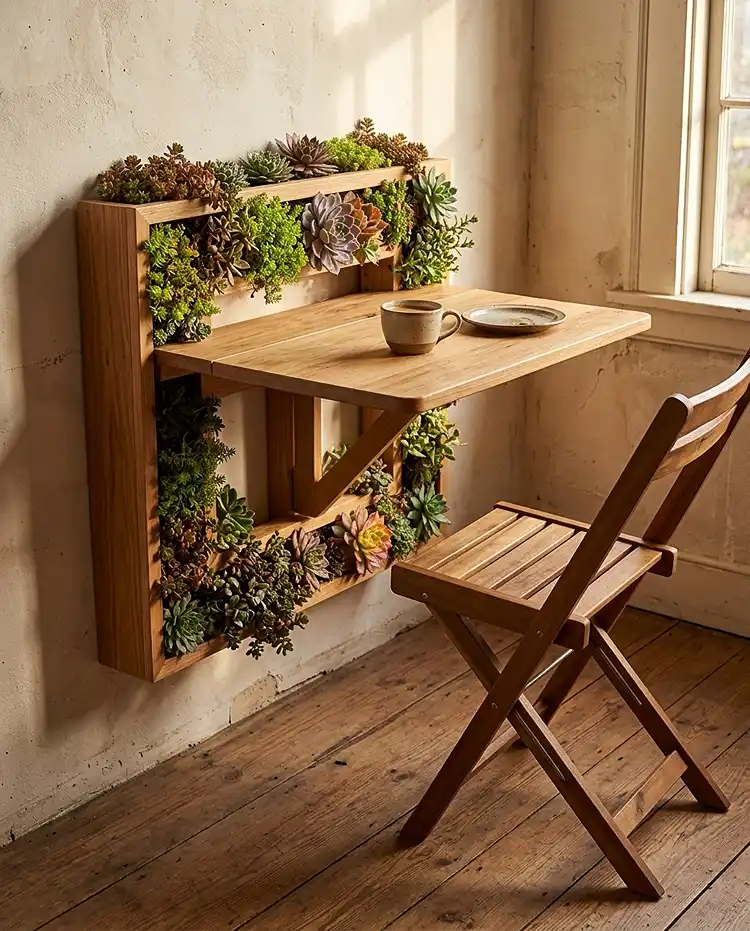
A wall-mounted drop-leaf bistro table folds flat against the wall, and its wooden frame doubles as a shadow-box planter. Fill the frame with sedum and other succulents. This one needs drilling into studs, so it suits owners or tenants with written approval.
Mastering Vertical Garden Watering, Feeding, and Seasonal Care
Short answer: Water top tiers more often than bottom ones, feed every two weeks at half strength, and trim crowded roots in spring. Vertical pockets hold little soil, so they swing from dry to soggy fast. A steady routine matters more than any single product.
Gravity-Fed Micro-Drip Irrigation and the Top-to-Bottom Watering Timing Chart
Short answer: Water the top tier daily in summer, the middle every other day, and the bottom every third day. A five-gallon bucket on a shelf can feed a quarter-inch micro-drip line through every pocket. Gravity does the work while you drink your coffee.
| Tier | Summer (80°F+) | Spring and fall | Good fits |
|---|---|---|---|
| Top (upper 2 ft) | Daily | Every 2 to 3 days | Sedum, rosemary, thyme |
| Middle | Every 2 days | Every 3 to 4 days | Oregano, lettuce, parsley |
| Bottom | Every 3 days | Every 4 to 5 days | Ferns, mint, creeping Jenny |
Always test first. Push a finger one inch into the soil, and water only if it feels dry.

Bi-Weekly Liquid Fertilizing, Root Pruning for Small Pockets, and Winterizing by Zone
Short answer: Feed confined roots every 14 days with half-strength kelp or fish emulsion. Root-prune overcrowded perennials each spring by trimming a third of the outer roots. Before hard freezes in zones 3 through 7, unmount thin wall pockets and store them somewhere sheltered.
In my zone 7a, the average last frost falls in mid-April. I start feeding once new growth appears, not before.
Common Problems & Solutions
Short answer: Three problems cause most vertical balcony failures: uneven drying, trapped moisture behind planters, and wind damage. Each one has a cheap fix involving plant placement, spacers, or better hardware. Spot them early, and your wall stays healthy through summer storms.
Top Tiers Baking Bone-Dry While Bottom Tiers Suffocate in Soggy Runoff
Short answer: Gravity pulls water downhill, so put drought-hardy succulents and rosemary on top and moisture-loving ferns and mint at the bottom. Add perforated plastic liners inside the upper pockets to slow drainage. Then the wall stays evenly moist instead of splitting into desert and swamp.
Green Algae, Mold, and Dampness Behind Wall-Mounted Felt Planters
Short answer: Breathable fabric pockets without backing trap moisture against brick or stucco. Mount planters on three-quarter-inch composite spacer strips so air can move behind them, and choose EPDM-lined [synthetic rubber] felt bags. That simple gap stops green stains and white mold.

I learned this the hard way in summer 2024. I hung a 12-pocket felt planter flush against my brick parapet and filled it with ‘Genovese’ basil.
Three weeks later, nine of the twelve plants were slimy, and the brick had a green stain. I rehung it on spacers with a waterproof liner. The next summer, I lost zero.
Vertical Trellises and Hanging Baskets Whipping and Tangling in High-Rise Winds
Short answer: Replace flimsy S-hooks with locking carabiner clips. During storms, tie basket bottoms to railing bars with clear nylon line, and zip-tie freestanding grids to railing posts. Wind finds every loose connection. A five-minute check before each storm saves plants, pots, and your neighbors’ patio furniture.
For more drill-free anchoring options, browse these renter-safe balcony planter ideas.
Frequently Asked Questions
How can I build a vertical garden on an apartment balcony without drilling into the walls?
Use four drill-free systems: floor-to-ceiling spring tension poles, over-the-rail saddle boxes, wire grids attached with stainless steel zip ties, and leaning A-frame ladder shelves. You can also wedge trellises inside heavy floor pots. A freestanding vertical garden tower on wheels works too, and everything comes down cleanly at move-out.
What are the best plants for small vertical wall pockets that dry out quickly?
For sunny walls, pick shallow-rooted, drought-forgiving plants like creeping thyme, oregano, sedums, hens and chicks, and portulaca. For shady walls, golden pothos, heartleaf philodendron, spider plants, and creeping Jenny cope well. Match each plant to the light and moisture of its tier.
Will a vertical wall garden stain my balcony wall or leak water downstairs?
Not if you plan for drainage. Use waterproof-backed pocket planters or modular panels with a bottom catch gutter, and set a narrow drip tray directly under the column. Spacer strips behind the planters also keep stains from forming.
How much weight can a balcony railing or wall safely hold for vertical planters?
As a rule of thumb, keep railing-hung planters under 15 to 20 pounds per linear foot by using a coco coir and perlite mix. Place heavy freestanding towers against the interior building wall, where structural joists are strongest. Check your railing’s rating with your building manager first.
Can I grow vegetables in a balcony vertical garden?
Yes, if you pick compact or climbing crops. Snap peas, mini cucumbers, lettuce, radishes, strawberries, and herbs all do well in vertical setups. Give them at least six hours of sun, and skip heavy feeders like full-size tomatoes unless you have a deep container.
Quick Recap
- Audit your walls, railings, corners, and ceiling before buying a single planter.
- Build your balcony vertical garden with zero-drill mounts and a featherweight potting mix.
- Plant drought-tolerant varieties up high and thirsty ones down low.
- Water top tiers more often, and feed every 14 days at half strength.
- Check hooks, spacers, and ties before every storm.